Within UFO Death Claims
How Viral Lists Make Weak Links Stronger
Viral lists often grow by adding loosely related people until the pattern looks stronger than the evidence supports.
On this page
- Adding names with loose criteria
- Mixing roles and institutions
- Why longer lists feel persuasive
Page outline Jump by section
Introduction
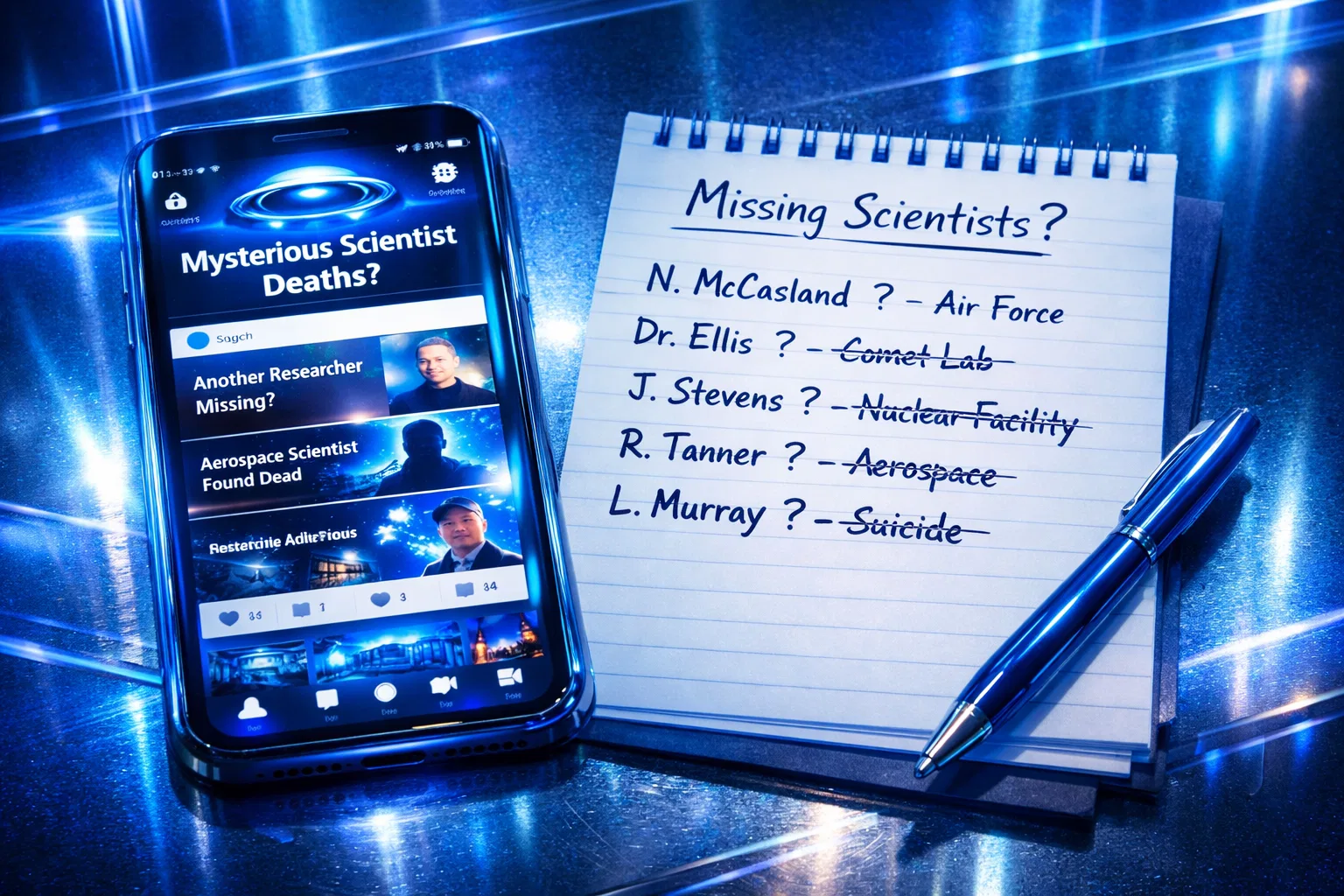
Online lists are one of the main ways the “dead or missing UFO and antigravity researchers” narrative becomes persuasive. A short claim may begin with one unresolved disappearance or one genuinely troubling death, but the list grows by adding people with looser and looser links: a retired military officer with historic aerospace roles, a Jet Propulsion Laboratory scientist who worked on comets, an administrative employee at a nuclear site, a fusion physicist killed in an apparently personal crime, or an antigravity enthusiast whose death has already been ruled a suicide. The result looks like a pattern before the evidence has shown one.
That is the core tactic: name inflation. Each added name increases the emotional weight of the claim while often weakening the evidential standard. Recent reporting on the 2026 “missing scientists” story shows this process clearly. The number cited in public discussion moved from a handful to 10, 11 or at least 12, while investigators and journalists repeatedly noted that no definitive public evidence had linked the cases or established coordinated foul play.[The Washington Post]washingtonpost.comOpen source on washingtonpost.com.
How a List Becomes Stronger Than Its Evidence
The persuasive force of these lists comes from accumulation. One death may be sad but explainable. Two disappearances may be worrying but unrelated. Ten names in a graphic, however, feel like a hidden system. The reader is invited to react to the length of the list before checking whether the people on it share the same work, the same institution, the same time period, the same type of incident, or the same evidence of foul play.
In the 2026 version of the claim, the Associated Press reported that speculation about links among deceased or missing scientists had been largely confined to niche online communities less than two months earlier, but by late April the number being discussed had grown to at least 12 and had reached the White House, the FBI and Congress. The same report noted that no evidence had been found that definitively linked the cases or proved coordinated wrongdoing.[The Washington Post]washingtonpost.comOpen source on washingtonpost.com.
The pattern is not that online posts invent every death. They usually start with real people and real tragedies. The inflation happens in the connective tissue: what counts as “linked”, what counts as “UFO-related”, what counts as “sensitive research”, and how much uncertainty is allowed before a name is treated as part of a single plot.
A typical inflated list uses several moves at once:
- It widens the time window. A claim framed as “recent” may quietly stretch over several years.
- It widens the job category. “Scientist” may expand to include administrators, contractors, retired officers, researchers in unrelated fields, and people with only broad institutional connections.
- It widens the subject link. “UFO researcher” may expand into aerospace, nuclear laboratories, rockets, advanced energy, classified work, defence employment, or proximity to institutions historically mentioned in UFO lore.
- It compresses different outcomes. Missing-person cases, suicides, homicides, natural deaths and undisclosed causes of death are placed in one column labelled “mysterious”.
- It treats unknown information as suspicious information. A missing public cause of death, a grieving family’s privacy, or an open investigation becomes part of the insinuation.
That structure is powerful because readers often process a list as a body of evidence, even when each item would look much weaker if examined separately.

Adding Names With Loose Criteria
Name inflation works by changing the entry requirements without announcing the change. A list may begin with someone who has a visible connection to antigravity or UFO discourse, then add people whose connection is really to space technology, defence research, nuclear laboratories, academia, or even merely a workplace associated with sensitive science.
William “Neil” McCasland shows how this process can start. His February 2026 disappearance attracted attention because he was a retired Air Force major general with past aerospace and research roles, including command of the Air Force Research Laboratory, and because online UFO communities associated him with older UFO-related discussion. But CBS News reported that his wife pushed back against the idea that he had been taken for secret knowledge, noting that he had retired more than 12 years earlier and joking about alien explanations to underline the absurdity of some speculation.[CBS News]cbsnews.comFBI investigating deaths and disappearances of staff at secretive government laboratories. Here's what we know. - CBS News…
Once McCasland became a focal point, older and different cases were pulled towards the same narrative. AP reported that people began pointing to other scientists who had died or gone missing, going back as far as June 2022. A Daily Mail article cited by AP had named five people in March 2026 and described a “chilling pattern”; by April, the story had expanded into a political and law-enforcement issue.[The Washington Post]washingtonpost.comOpen source on washingtonpost.com.
The House Oversight Committee’s April 2026 press release illustrates another layer: official attention can cite “unconfirmed public reporting” while still amplifying the list format. The committee said it was seeking information from the Department of Energy, Department of War, FBI and NASA about scientists and other personnel connected to nuclear secrets or rocket technology who had died or vanished. It described reports alleging at least ten individuals with such connections and listed broad categories including NASA JPL alumni, Los Alamos personnel, an MIT fusion scientist, a pharmaceutical researcher and a nuclear-weapons-component contractor.[House Oversight Committee]oversight.house.govOpen source on house.gov.
That is not the same as proof of a coordinated pattern. It is a request for information built around a reported cluster. But once the request exists, online lists can present official concern as if it validates the most dramatic interpretation. The distinction between “authorities are checking whether there is a link” and “authorities have found a link” often disappears in viral retellings.
Mixing Roles and Institutions
A major inflation tactic is institutional halo: attaching a name to a prestigious or secretive institution so that the person appears closer to the alleged hidden programme than the evidence supports. In this topic, the institutions do much of the rhetorical work. NASA’s Jet Propulsion Laboratory, Los Alamos National Laboratory, MIT, the Air Force Research Laboratory and nuclear-weapons facilities all sound consequential. In a list, that atmosphere of secrecy can substitute for a demonstrated operational connection.
CBS News reported that the cases under discussion involved researchers and other staff with ties to NASA JPL and Los Alamos, but also stressed that the facilities and laboratories involved employ large numbers of people, including administrative and support staff who may not have access to secret information. One former Energy Department official told CBS that attaching a nuclear-weapons facility and a technical-sounding job title can conceal how ordinary someone’s role may be.[CBS News]cbsnews.comFBI investigating deaths and disappearances of staff at secretive government laboratories. Here's what we know. - CBS News…
This matters because the UFO and antigravity frame depends on a stronger claim than “some people worked somewhere important”. It requires evidence that the individuals shared relevant knowledge, projects, threats, adversaries or circumstances. CBS reported that experts it interviewed saw no obvious link between the cases, and quoted Joseph Rodgers of the Center for Strategic and International Studies saying he would be more suspicious if all the scientists had been working on one project or weapons system.[CBS News]cbsnews.comFBI investigating deaths and disappearances of staff at secretive government laboratories. Here's what we know. - CBS News…
The same problem appears when different scientific fields are blended together. Asteroid research, materials processing, plasma physics, pharmaceuticals, nuclear-site administration and aerospace programme management may all sound “advanced” to a non-specialist audience, but they are not automatically part of a single UFO, antigravity or exotic propulsion network. The broader the category becomes, the easier it is to add names and the less the category proves.
Why Longer Lists Feel Persuasive
Long lists exploit a real human tendency: we are pattern-seeking creatures. That ability is useful in many contexts, but it can also make unrelated events feel connected. Psychological research on conspiracy belief has repeatedly examined “illusory pattern perception”, the tendency to perceive meaningful patterns in random or unrelated information. A 2017 study by Jan-Willem van Prooijen and colleagues concluded that illusory pattern perception was a central cognitive mechanism associated with conspiracy and supernatural beliefs.[PMC]pmc.ncbi.nlm.nih.govOpen source on nih.gov.
In this subject, the effect is intensified by grief, secrecy and partial information. A missing person has no final explanation. A family may not release a cause of death. A homicide investigation may leave motives unclear. A laboratory may be sensitive for reasons unrelated to the person’s own role. Each gap creates space for a list-maker to imply connection without proving it.
AP quoted Jen Golbeck, a University of Maryland professor who studies conspiracy theories, saying that the sinister-link idea is a common trope: many people work at national labs, universities and government research centres, and in any year some will go missing, die by suicide or die from other causes. Her point was not that the cases are unimportant, but that one can select a set of tragedies and make them look sinister if the criteria are flexible enough.[The Washington Post]washingtonpost.comOpen source on washingtonpost.com.
That is why a longer list can actually be a warning sign. If each added name requires a looser definition than the last, the list is not becoming stronger; it is becoming more elastic. A robust pattern normally gets sharper as evidence accumulates. An inflated pattern gets blurrier.
The “Mysterious” Label Does Too Much Work
In viral versions of this story, the word “mysterious” often covers several different situations. Some cases are genuinely unresolved. Some are missing-person cases. Some involve violent crime. Some involve deaths where families or authorities have not publicised every detail. Some have known or likely explanations that are less dramatic than the list suggests.
El País reported, for example, that MIT physicist Nuno Loureiro’s murder fuelled conspiracy theories, but that the suspected perpetrator had also killed others and died by suicide, while indications pointed towards a personal matter involving resentment rather than a science-suppression plot.[EL PAÍS English]english.elpais.comOpen source on elpais.com.
CBS similarly described the overall set as disparate. It reported that of the ten cases drawing speculation online, one person disappeared while hiking in California, five had died, and four people ranging from a general to an administrative staffer had gone missing in New Mexico over roughly a year. It also noted that people involved in the various investigations described the underlying stories not as a spy-thriller plot but as personal and tragic.[CBS News]cbsnews.comFBI investigating deaths and disappearances of staff at secretive government laboratories. Here's what we know. - CBS News…
This does not mean every case is solved. It means “unsolved”, “private”, “violent”, “sudden”, “classified-adjacent” and “UFO-related” are not interchangeable labels. Inflated lists often depend on treating them as if they are.
Official UAP Interest Is Not Proof of a Death Pattern
The wider UFO setting gives these lists much of their energy because UAP research has had real government attention. That part is true. The U.S. All-domain Anomaly Resolution Office, or AARO, has reviewed historical UAP investigations, and NASA convened an independent study team to examine how better data could improve UAP research.[U.S. Department of War]media.defense.govDOPSR 2024 0263 AARO HISTORICAL RECORD REPORT VOLUMEDOPSR 2024 0263 AARO HISTORICAL RECORD REPORT VOLUME
But those official records point in a different direction from the viral death-list narrative. NASA’s 2023 independent UAP report stated that, in peer-reviewed scientific literature, there was no conclusive evidence suggesting an extraterrestrial origin for UAP and emphasised the need for better data. AARO’s 2024 historical report likewise found no evidence that U.S. government investigations, academic research or official review panels had confirmed UAP sightings as extraterrestrial technology.[NASA Science]science.nasa.govOpen source on nasa.gov.
That distinction is important. “The government has studied UAP” is a documented statement. “People are being killed because they knew the truth about UFOs or antigravity” is a far stronger claim and requires far stronger evidence. Viral lists often slide between those two propositions, using the credibility of the first to make the second feel more plausible.
Antigravity adds another ambiguity. Some people on online lists are described as antigravity researchers, advanced propulsion figures or exotic-energy researchers. Yet the existence of speculative research, fringe engineering efforts, or official curiosity about advanced aerospace concepts does not demonstrate that a working antigravity programme exists, nor that deaths around loosely adjacent people are connected.
How to Read These Lists Without Dismissing Real Tragedies
A careful reader does not have to choose between credulity and contempt. The people named in these lists were real individuals with families, colleagues and communities. Some cases deserve investigation on their own terms. What fails is the shortcut from “several sad or unresolved cases exist” to “there is a coordinated campaign against UFO or antigravity researchers”.
The practical test is to examine the list item by item, not as a single dramatic block:
- What was the person’s actual role? A scientist, administrator, contractor, retired officer and public UFO commentator are different categories.
- What is the specific UFO or antigravity connection? Direct research, passing institutional association, old aerospace work and online speculation should not be treated as equal.
- What is the known incident type? Missing-person case, homicide, suicide, natural death and undisclosed cause of death require different evidentiary standards.
- What is the time span? A claim about “recent” deaths becomes weaker if it quietly reaches back several years.
- What do family members, investigators and primary records say? Their statements may not answer every question, but they are stronger evidence than anonymous list graphics.
- Does the list get more precise as it grows? If the criteria keep expanding, the list may be manufacturing scale rather than revealing a pattern.
CBS News reported that the FBI was looking for possible connections, while also reporting that people close to the separate investigations saw no links and that experts interviewed by CBS saw no obvious connection among the cases. That is the balanced position the evidence supports: investigation is legitimate; a coordinated UFO or antigravity death pattern has not been publicly demonstrated.[CBS News]cbsnews.comFBI investigating deaths and disappearances of staff at secretive government laboratories. Here's what we know. - CBS News…
The Takeaway: Count Inflation Is Not Corroboration
The central weakness of viral “dead or missing scientists” lists is that the count often grows faster than the proof. A list that moves from five to ten to eleven to twelve names can look increasingly compelling, but only if readers ignore how the definitions changed along the way. When “UFO researcher” becomes “anyone with a defence, aerospace, laboratory, nuclear, propulsion, space or advanced-science connection”, almost any large research ecosystem can be mined for tragedies.
That does not make every concern baseless. Sensitive scientific institutions can face espionage risks, and unresolved disappearances deserve serious attention. But the specific online tactic is different: it uses loose criteria, institutional aura and emotional accumulation to make weak links feel strong.
For the UFO and antigravity deaths narrative, the strongest current conclusion is restrained. There are real deaths, real disappearances and real official efforts to check whether any links exist. There is not, based on the public evidence now available, a demonstrated pattern of scientists being eliminated because of UFO or antigravity knowledge. The viral list format is part of why the claim travels so well — and part of why it needs to be read so carefully.
Amazon book picks
Further Reading
Books and field guides related to How Viral Lists Make Weak Links Stronger. Use these as the next step if you want deeper reading beyond the article.
Mistakes Were Made (but Not by Me)
Explains confirmation bias and self-justification mechanisms that help weakly connected claims grow into persuasive stories.
The Demon-Haunted World
Rating: 4.5/5 from 43 Google Books ratings
Explains how accumulation of anecdotes and weak evidence can create persuasive but unsupported narratives.
Calling Bullshit
Shows how misleading presentations, lists, and selective evidence can create false impressions of patterns.
Suspicious Minds
Directly addresses why long chains of connected names and events can appear more convincing than the evidence warrants.
eBay marketplace picks
Marketplace Samples
Live-tested eBay searches with available results related to this page.




Endnotes
1.
Source: cbsnews.com
Title: CBS News
Link:https://www.cbsnews.com/news/deaths-disappearances-scientists-staff-government-labs/
Source snippet
FBI investigating deaths and disappearances of staff at secretive government laboratories. Here's what we know. - CBS News...
2.
Source: oversight.house.gov
Link:https://oversight.house.gov/release/comer-burlison-seek-information-on-missing-nuclear-and-rocket-scientists/
3.
Source: pmc.ncbi.nlm.nih.gov
Link:https://pmc.ncbi.nlm.nih.gov/articles/PMC5900972/
4.
Source: science.nasa.gov
Link:https://science.nasa.gov/wp-content/uploads/2023/09/uap-independent-study-team-final-report.pdf
5.
Source: oversight.house.gov
Title: DOE Missing Scientists Letter 4.20.26
Link:https://oversight.house.gov/wp-content/uploads/2026/04/DOE-Missing-Scientists-Letter_4.20.26.pdf
6.
Source: aaro.mil
Link:https://www.aaro.mil/UAP-Cases/Official-UAP-Imagery/
7.
Source: aaro.mil
Link:https://www.aaro.mil/
8.
Source: science.nasa.gov
Link:https://science.nasa.gov/uap/
9.
Source: war.gov
Title: dod report discounts sightings of extraterrestrial technology
Link:https://www.war.gov/News/News-Stories/Article/Article/3701297/dod-report-discounts-sightings-of-extraterrestrial-technology/
10.
Source: washingtonpost.com
Link:https://www.washingtonpost.com/politics/2026/04/24/scientists-missing-dead-conspiracy-theories/73473d76-4013-11f1-bb46-ed564688d953_story.html
11.
Source: english.elpais.com
Link:https://english.elpais.com/science-tech/2026-04-27/missing-and-dead-scientists-the-conspiracy-theory-being-investigated-by-the-fbi-and-congress.html
12.
Source: media.defense.gov
Title: DOPSR 2024 0263 AARO HISTORICAL RECORD REPORT VOLUME 1 2024
Link:https://media.defense.gov/2024/Mar/08/2003409233/-1/-1/0/DOPSR-2024-0263-AARO-HISTORICAL-RECORD-REPORT-VOLUME-1-2024.PDF
13.
Source: cbsnews.com
Link:https://www.cbsnews.com/video/fbi-investigating-deaths-disappearances-staff-secretive-government-laboratories/
14.
Source: cbsnews.com
Link:https://www.cbsnews.com/losangeles/video/fbi-investigation-deaths-and-disappearances-of-notable-scientists-working-at-government-laboratories/
15.
Source: cbsnews.com
Title: nasa ufo report uap study
Link:https://www.cbsnews.com/news/nasa-ufo-report-uap-study/
16.
Source: pmc.ncbi.nlm.nih.gov
Link:https://pmc.ncbi.nlm.nih.gov/articles/PMC12652441/
17.
Source: washingtonpost.com
Title: nasa ufo report uap panel
Link:https://www.washingtonpost.com/national-security/2023/09/14/nasa-ufo-report-uap-panel/
Additional References
18.
Source: youtube.com
Title: UFOs and missing scientists: Are conspiracy theories mainstream?
Link:https://www.youtube.com/watch?v=H_dDQ-IqnT0
Source snippet
FBI says it is looking into whether cases of missing and dead scientists are linked...
19.
Source: youtube.com
Link:https://www.youtube.com/watch?v=s47RUJu1oBY
Source snippet
The Disturbing Pattern of Dead & Missing Scientists...
20.
Source: youtube.com
Title: UFO insider reveals pattern behind missing scientists
Link:https://www.youtube.com/watch?v=YcHt-OBkabU
Source snippet
Missing scientists case less 'Men in Black,' more espionage...
21.
Source: youtube.com
Title: The Disturbing Pattern of Dead & Missing Scientists
Link:https://www.youtube.com/watch?v=tkKTDnPVitQ
Source snippet
UFO insider reveals pattern behind missing scientists...
22.
Source: hindustantimes.com
Link:https://www.hindustantimes.com/world-news/us-news/10-us-scientists-researching-ufos-nuclear-power-dead-or-missing-since-mid-2023-trump-admin-speaks-out-101776332868123.html
23.
Source: medium.com
Link:https://medium.com/%40Reiki32/11-researchers-connected-to-ufos-and-nuclear-secrets-are-gone-37932a721174
24.
Source: vanityfair.com
Link:https://www.vanityfair.com/news/story/missing-scientists-conspiracy-theories-white-house?srsltid=AfmBOopBHqZWVeSmTB9dJwr7ltolwLnEV60HfII_yo5svzm15cjEPKlr
25.
Source: ibtimes.co.uk
Link:https://www.ibtimes.co.uk/mysterious-death-anti-gravity-scientist-ufo-conspiracy-1792209
26.
Source: aol.com
Link:https://www.aol.com/articles/11th-scientist-death-emerges-string-153720581.html
27.
Source: ibtimes.co.uk
Link:https://www.ibtimes.co.uk/grieving-father-dismisses-conspiracy-theories-1792374
Topic Tree