Within Viral Lists
Who Counts As A Scientist In The List?
A list can sound more alarming when researchers, administrators, contractors and retired officials are all presented as the same kind of scientist.
On this page
- Researchers, staff and contractors in one column
- Why job labels matter to the claim
- Questions to ask before accepting a title
Page outline Jump by section
Introduction
Lists that claim large numbers of UFO, antigravity, aerospace or advanced-technology researchers have died under suspicious circumstances often gain persuasive power from a simple presentation choice: everyone is labelled a “scientist”. In practice, however, such lists frequently combine very different kinds of people—research scientists, engineers, programme managers, laboratory technicians, contractors, administrators, consultants and retired officials—into a single category. That can make the group appear more uniform, specialised and connected than it really is.
 The issue is not that these roles are unimportant. Modern research depends on a wide range of personnel. The problem arises when a list implies that all names represent the same type of researcher working on the same type of sensitive knowledge. Evaluating a suspicious-deaths claim requires knowing who the people actually were, what work they performed, and whether their connection to the alleged subject matter is direct or merely institutional. International research-statistics standards themselves distinguish researchers from technicians and support staff, precisely because these are different functions within the research ecosystem.[oecd.org]oecd.org9789264239012 enFrascati Manual 2015 (EN)Furthermore, by providing internationally accepted definitions of R&D and classifications of its component a…
Who Counts As A Scientist In The List?
The word “scientist” sounds straightforward, but real research organisations use a wide variety of job titles that do not all mean the same thing.
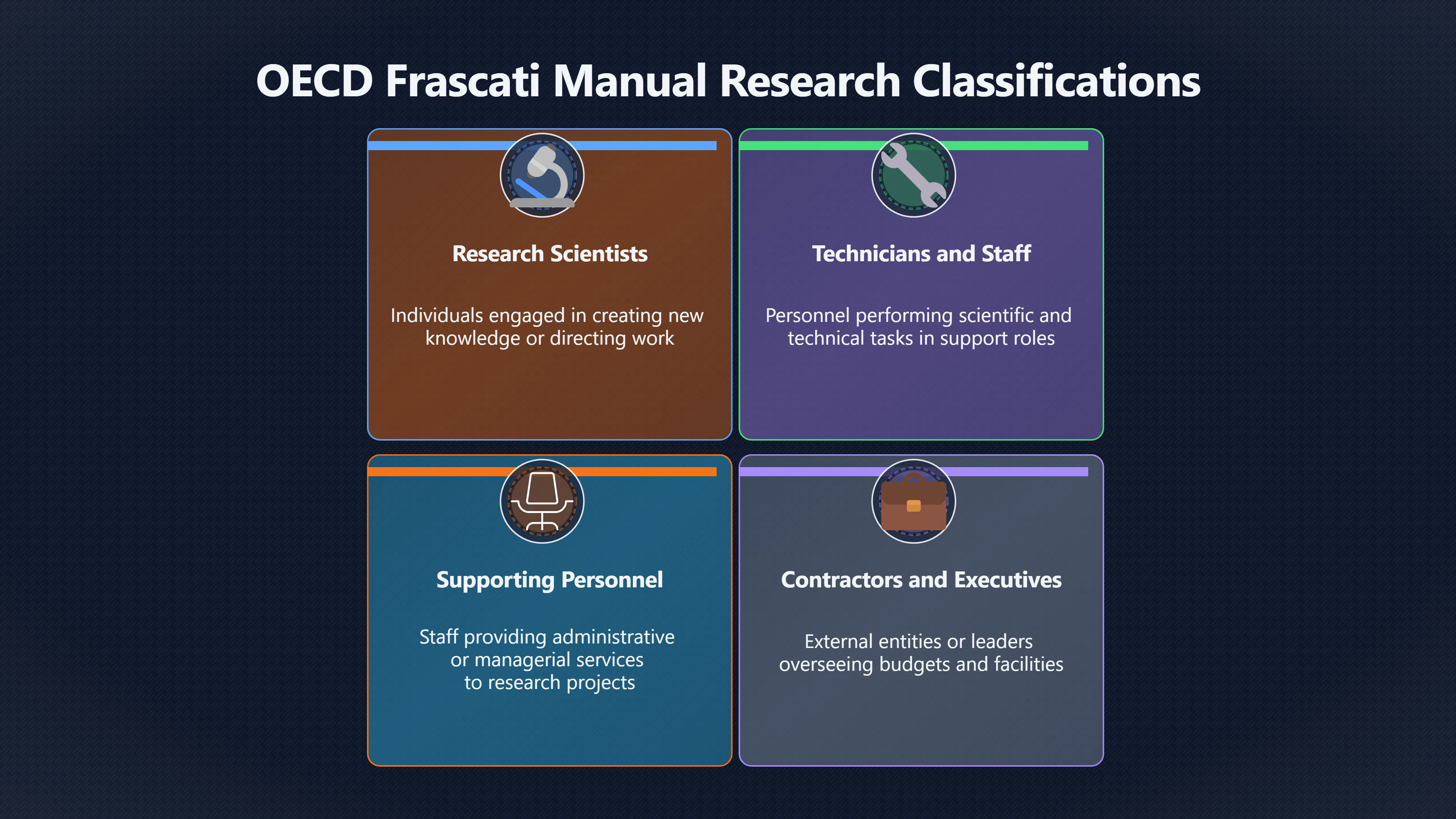
According to the OECD’s Frascati Manual, the internationally recognised framework used to classify research and development personnel, research organisations distinguish among researchers, technicians and equivalent staff, and supporting personnel. Researchers are those engaged in creating new knowledge or directing such work. Technicians perform scientific and technical tasks, usually in support of research. Other staff may provide administrative, managerial or operational services directly associated with research projects.[oecd.org]oecd.org9789264239012 enFrascati Manual 2015 (EN)Furthermore, by providing internationally accepted definitions of R&D and classifications of its component a…
This distinction matters because a list may accurately state that someone worked at a laboratory, defence contractor or aerospace organisation while leaving readers with the impression that the person was a lead researcher on classified scientific projects.
Researchers, staff and contractors in one column
Many “scientist death” compilations effectively merge several populations:
- Research scientists conducting original investigations.
- Engineers developing systems or products.
- Technical specialists operating equipment.
- Laboratory managers and programme administrators.
- Contract employees working for organisations that perform research.
- Retired officials who previously held scientific or technical posts.
- Executives overseeing research budgets or facilities.
A person can have a genuine connection to a scientific institution without being a researcher in the narrow sense. Likewise, someone may hold a highly technical role while never working on the specific UFO or antigravity topics implied by a list.
The problem becomes even greater when titles are taken from employment records without context. Universities, laboratories and companies often use institution-specific titles whose meanings vary widely. A “research scientist”, “staff scientist”, “technical officer”, “programme manager” or “principal specialist” may have very different responsibilities depending on the organisation. Academic and industrial sectors do not use a single universal hierarchy of research titles.[ASCB]ascb.orgThe stranger in the lab: Staff scientists—who they are,The stranger in the lab: Staff scientists—who they are…March 9, 2018 — 9 Mar 2018 — Staff scientists have different titles in dif…
Why Job Labels Matter To The Claim
A suspicious-deaths narrative usually depends on an implied mechanism: people supposedly possessed sensitive knowledge and were therefore targeted. The credibility of that implication depends heavily on the actual role each person held.
If a list contains ten names presented as “scientists”, readers may imagine ten individuals independently generating or possessing specialised knowledge. If closer inspection shows that the group includes administrators, contractors, support personnel and retired managers, the evidential picture changes substantially.
Institutional proximity is not the same as research involvement
One common inflation tactic is to treat employment at a research institution as equivalent to participation in a specific research programme.
For example, an individual may have worked at a national laboratory, aerospace contractor or defence facility. That fact alone does not establish involvement in advanced propulsion research, UFO investigations or other sensitive subjects. Large organisations employ thousands of people across finance, procurement, facilities management, information technology, security, administration and many other functions.
When a list replaces detailed job descriptions with the simpler label “scientist”, readers can easily assume a stronger connection than the evidence supports.
Technical expertise does not establish topic relevance
Another issue is that scientific and technical expertise is often transferred from one field to another in conspiracy-oriented retellings.
A physicist, aerospace engineer, chemist, software specialist or nuclear researcher may all be grouped together under the implication that they shared access to hidden UFO-related knowledge. Yet expertise in one technical area does not automatically create a meaningful connection to another.
The result is a category that appears coherent only because occupational differences have been removed.
The title itself may be misleading
Modern organisations frequently use titles that contain scientific language even when the primary duties are managerial, commercial or operational.
Industry examples include roles such as field application scientist, scientific liaison, programme scientist, staff scientist, research manager and technical consultant. Some positions involve direct experimentation and publication; others focus on customer support, project coordination, facility management or communication between teams. The title alone often provides an incomplete picture of what the individual actually did.[LinkedIn]linkedin.comLinked In Most Ph Ds have zero training on what industry job titlesMost PhDs have zero training on what industry job titles…September 12, 2025 — A field application scientist is a client facing…
For this reason, a list built primarily from job titles can create an illusion of similarity among people whose daily work differed substantially.
How Mixed Titles Create The Appearance Of A Pattern
The power of a suspicious-deaths list comes from aggregation. Once enough names appear together, readers naturally search for common factors.
Mixing job categories strengthens that effect in several ways:
It increases the apparent size of the target population. A narrow group of researchers becomes a much larger group when contractors, managers and support staff are added.
It creates artificial uniformity. Different careers are compressed into a single label, making unrelated individuals seem comparable.
It obscures differences in access and responsibility. A laboratory director, equipment technician and external consultant may all appear equally central to a project when they were not.
It encourages assumption rather than verification. Readers often infer that everyone on the list possessed similar knowledge even when no evidence demonstrates that.
These effects do not prove that any individual case is mundane or unimportant. Rather, they show why occupational precision matters before broader conclusions are drawn.

Questions To Ask Before Accepting A Title
When evaluating a list of allegedly targeted UFO or antigravity researchers, several basic questions can help determine whether occupational labels are being used accurately.
What was the person’s actual role?
Look beyond the headline title.
Was the individual:
- Conducting original research?
- Managing a programme?
- Providing technical support?[linkedin.com]linkedin.comClare McLaren's PostIt separately recognises technicians and equivalent staff as part of the R&D workforce when they are undertaking tech…
- Working as a contractor?
- Employed in administration or operations?
- Retired from the field years earlier?
The answer often reveals a more nuanced picture than the label “scientist”.
What evidence links the person to the claimed subject?
A meaningful connection requires more than employment at a scientific institution.
Ask whether there is documented evidence that the individual worked on:
- Advanced propulsion research.
- UFO-related investigations.
- Classified aerospace programmes.
- The specific topic cited by the list.
Without such evidence, the connection may rest largely on institutional association.
Is the title current, historical or honorary?
Lists sometimes use the most impressive title from a person’s career even if it no longer reflected their role at the time of death or disappearance.
A retired official may be presented as an active researcher. A former engineer may be described as a scientist. A manager who once worked in technical research may be portrayed as directly involved in ongoing projects.
These distinctions can materially affect how relevant a person is to the claimed pattern.
Are multiple categories being combined?
Finally, ask whether the list clearly separates:
- Researchers.
- Engineers.
- Technicians.
- Contractors.
- Administrators.
- Executives.
- Former personnel.
If all appear under one heading, the apparent pattern may owe as much to categorisation choices as to the underlying events themselves.
The Key Reliability Test
In discussions about alleged suspicious deaths connected to UFO or antigravity research, occupational accuracy is not a minor detail. It is part of the evidence itself.
A list becomes more credible when it precisely identifies who each person was, what work they actually performed, and how that work relates to the subject being claimed. Conversely, when researchers, support staff, contractors, administrators and retired officials are all presented as interchangeable “scientists”, the list may look stronger than the underlying evidence warrants.
The central question is therefore not whether every individual had some connection to science or technology. It is whether the people on the list genuinely belong to the same relevant category. Without that step, a collection of disparate careers can be mistaken for a single targeted population.[oecd.org]oecd.org9789264239012 enFrascati Manual 2015 (EN)Furthermore, by providing internationally accepted definitions of R&D and classifications of its component a…
Amazon book picks
Further Reading
Books and field guides related to Who Counts As A Scientist In The List?. Use these as the next step if you want deeper reading beyond the article.
What is this Thing Called Science?
Rating: 3.5/5 from 5 Google Books ratings
Explores what qualifies as science and how scientific authority should be assessed.
The Structure of Scientific Revolutions
Helps readers think critically about scientific communities, expertise, and who participates in knowledge production.
Merchants of Doubt
Shows why understanding credentials, roles, and authority matters when evaluating technical claims.
The Craft of Research
Provides insight into how research is actually conducted and the roles involved in producing knowledge.
eBay marketplace picks
Marketplace Samples
Live-tested eBay searches with available results related to this page.


Endnotes
1.
Source: oecd.org
Title: 9789264239012 en
Link:https://www.oecd.org/content/dam/oecd/en/publications/reports/2015/10/frascati-manual-2015_g1g57dcb/9789264239012-en.pdf
Source snippet
Frascati Manual 2015 (EN)Furthermore, by providing internationally accepted definitions of R&D and classifications of its component a...
2.
Source: oecd.org
Link:https://www.oecd.org/en/about/projects/frascati-manual-development.html
Source snippet
Continuing development of the OECD Frascati ManualUsed worldwide, the OECD Frascati Manual underpins global R&D data collection and infor...
3.
Source: ascb.org
Title: The stranger in the lab: Staff scientists—who they are,
Link:https://www.ascb.org/careers/stranger-lab-staff-scientists-improve-academia/
Source snippet
The stranger in the lab: Staff scientists—who they are...March 9, 2018 — 9 Mar 2018 — Staff scientists have different titles in dif...
Published: March 9, 2018
4.
Source: linkedin.com
Title: Linked In Most Ph Ds have zero training on what industry job titles
Link:https://www.linkedin.com/posts/mohamad-alhajj_most-phds-have-zero-training-on-what-industry-activity-7372207246157484032–0Bw
Source snippet
Most PhDs have zero training on what industry job titles...September 12, 2025 — A field application scientist is a client facing...
Published: September 12, 2025
5.
Source: linkedin.com
Link:https://www.linkedin.com/posts/allaei_heres-the-hard-truth-traditional-applied-activity-7421928252048543745-rUZa
Source snippet
Hamed Seyed-allaei, PhD's Post"Here's the hard truth: Traditional applied scientist roles in corporations are often terrible fits for peo...
6.
Source: linkedin.com
Link:https://www.linkedin.com/posts/claremclaren_one-of-the-most-useful-things-i-have-read-activity-7449073118452666368-x-xD
Source snippet
Clare McLaren's PostIt separately recognises technicians and equivalent staff as part of the R&D workforce when they are undertaking tech...
7.
Source: oecd.org
Title: frascati manual 2015 g1g57dcb
Link:https://www.oecd.org/en/publications/2015/10/frascati-manual-2015_g1g57dcb.html
Source snippet
Frascati Manual 2015It includes definitions of basic concepts, data collection guidelines, and classifications for compiling R&D statisti...
8.
Source: one.oecd.org
Link:https://one.oecd.org/document/DSTI/STP/NESTI%282024%293/REV2/en/pdf
Source snippet
of software development for R&D measurement14 Feb 2025 — This document responds to widespread requests for specific guidance on the R&D t...
9.
Source: csu.gov.cz
Title: Statistika Methodology
Link:https://csu.gov.cz/methodology-rd-personnel
Source snippet
StatistikaMethodology - R&D personnel | StatisticsR&D personnel Persons employed in research and development technicians and equivalent s...
10.
Source: slideshare.net
Title: frascati manual 2015
Link:https://www.slideshare.net/slideshow/frascati-manual-2015/54058209
Source snippet
Manual 2015 | PPTX... (researchers, technicians, other supporting staff). • Definition of researchers has been changed: – Researchers are...
11.
Source: warwick.ac.uk
Title: frascati manual 2015
Link:https://warwick.ac.uk/services/ris/systems/dataquality/frascati/frascati_manual_2015.pdf
Source snippet
The frascati Manual is firmly based on experience gained from collecting R&D statistics in both OECD and non-member countries. It is a re...
12.
Source: unstats.un.org
Link:https://unstats.un.org/unsd/classifications/Family/Detail/1038
Source snippet
Classification Detail - the United NationsOECD (2015), Frascati Manual 2015: Guidelines for Collecting and Reporting Data on Research a...
Additional References
13.
Source: facebook.com
Link:https://www.facebook.com/groups/2362074407344426/posts/3563825500502638/
Source snippet
EPA or NOAA employees: Misleading job titles?Have you found the job titles are misleading? E.g., I was hired as a life scientist but they...
14.
Source: tacr.gov.cz
Link:https://tacr.gov.cz/dokums_raw/novinky/Frascati2015_Chapter2_definitions.pdf
Source snippet
and definitions for identifying R&DThe definition of r&d just given is consistent with the definition of r&d used in the previous edition...
15.
Source: scientificsearch.com
Title: how job titles are secretly holding back innovation
Link:https://scientificsearch.com/blog/how-job-titles-are-secretly-holding-back-innovation/
Source snippet
How Job Titles Are (Secretly) Holding Back Innovation10 Mar 2026 — In most industries, job titles are meant to bring clarity. They help p...
16.
Source: reddit.com
Title: can someone explain the differences in different
Link:https://www.reddit.com/r/biotech/comments/if0abb/can_someone_explain_the_differences_in_different/
17.
Source: research-services.admin.cam.ac.uk
Title: cam.ac.uk Frascati definition of research
Link:https://www.research-services.admin.cam.ac.uk/prepare-and-submit-application/eligibility-and-deadlines/frascati
Source snippet
definition of research - Research ServicesThe internationally recognised definition is taken from the Frascati Manual[1], an OECD publica...
18.
Source: academia.stackexchange.com
Title: (2 answers) Closed 5 years ago. Is
Link:https://academia.stackexchange.com/questions/31296/is-there-a-common-standard-for-the-title-hierarchy-of-research-positions-in-engl
Source snippet
Academia Stack ExchangeIs there a common standard for the title hierarchy of...7 Nov 2014 — This question already has answers here: Is t...
19.
Source: youtube.com
Link:https://www.youtube.com/watch?v=s47RUJu1oBY
Source snippet
The Disturbing Pattern of Dead & Missing Scientists...
20.
Source: pmc.ncbi.nlm.nih.gov
Link:https://pmc.ncbi.nlm.nih.gov/articles/PMC2685008/
Source snippet
D Fanelli · 2009 · Cited by 2719 — A pooled weighted average of 1.97% scientists admitted to have fabricated, falsified or modifi...
21.
Source: databank.worldbank.org
Title: SP.POP.TEC H.RD.P6
Link:https://databank.worldbank.org/metadataglossary/world-development-indicators/series/SP.POP.TECH.RD.P6
Source snippet
in R&D (per million people) - Glossary | DataBankTechnicians and equivalent staff are people who perform scientific and technical tasks i...
22.
Source: youtube.com
Title: Are These Scientist Disappearances and Deaths Connected?
Link:https://www.youtube.com/watch?v=fcWF7hr8Foc
Source snippet
UFOs and missing scientists: Are conspiracy theories mainstream?...
Topic Tree