Within Clusters
When the Target Is Drawn Afterward
The same list can look ominous when the boundary is drawn after the deaths are already known.
On this page
- How post hoc boundaries create apparent patterns
- Why changing case rules changes the story
- Checks that separate clusters from coincidences
Page outline Jump by section
Introduction
Lists of allegedly “dead” or “disappeared” scientists connected to UFO research, advanced propulsion, aerospace projects or speculative antigravity concepts often appear persuasive because they present a cluster of disturbing cases in one place. The Texas Sharpshooter Error explains why such lists can create a misleading impression of a hidden pattern even when the underlying events are unrelated. The error occurs when investigators, writers or online communities identify unusual cases first and only afterwards draw the boundary that makes them appear connected. Rather than testing a pre-defined hypothesis, the target is drawn around the bullet holes after they have already been noticed. This mechanism is one of the most important reasons coincidence clusters can look suspicious without demonstrating a common cause.[Wikipedia]WikipediaTexas sharpshooter fallacyTexas sharpshooter fallacy
 Within debates about UFO-related scientist deaths, the Texas Sharpshooter Error does not prove that every case is ordinary. Instead, it highlights a methodological problem: a list assembled after the fact can appear meaningful even when the selection process itself created the appearance of a pattern.[Wikipedia]WikipediaTexas sharpshooter fallacyTexas sharpshooter fallacy
When the Target Is Drawn Afterwards
The classic metaphor involves a shooter firing randomly at a barn and then painting a bullseye around the tightest cluster of holes. The cluster looks impressive only because the target was defined after the shots landed. In statistics and critical reasoning, the same mistake occurs when people search through many events, identify a group that looks unusual, and then treat that group as evidence of a pre-existing pattern.[wikipedia.org]WikipediaTexas sharpshooter fallacyTexas sharpshooter fallacy
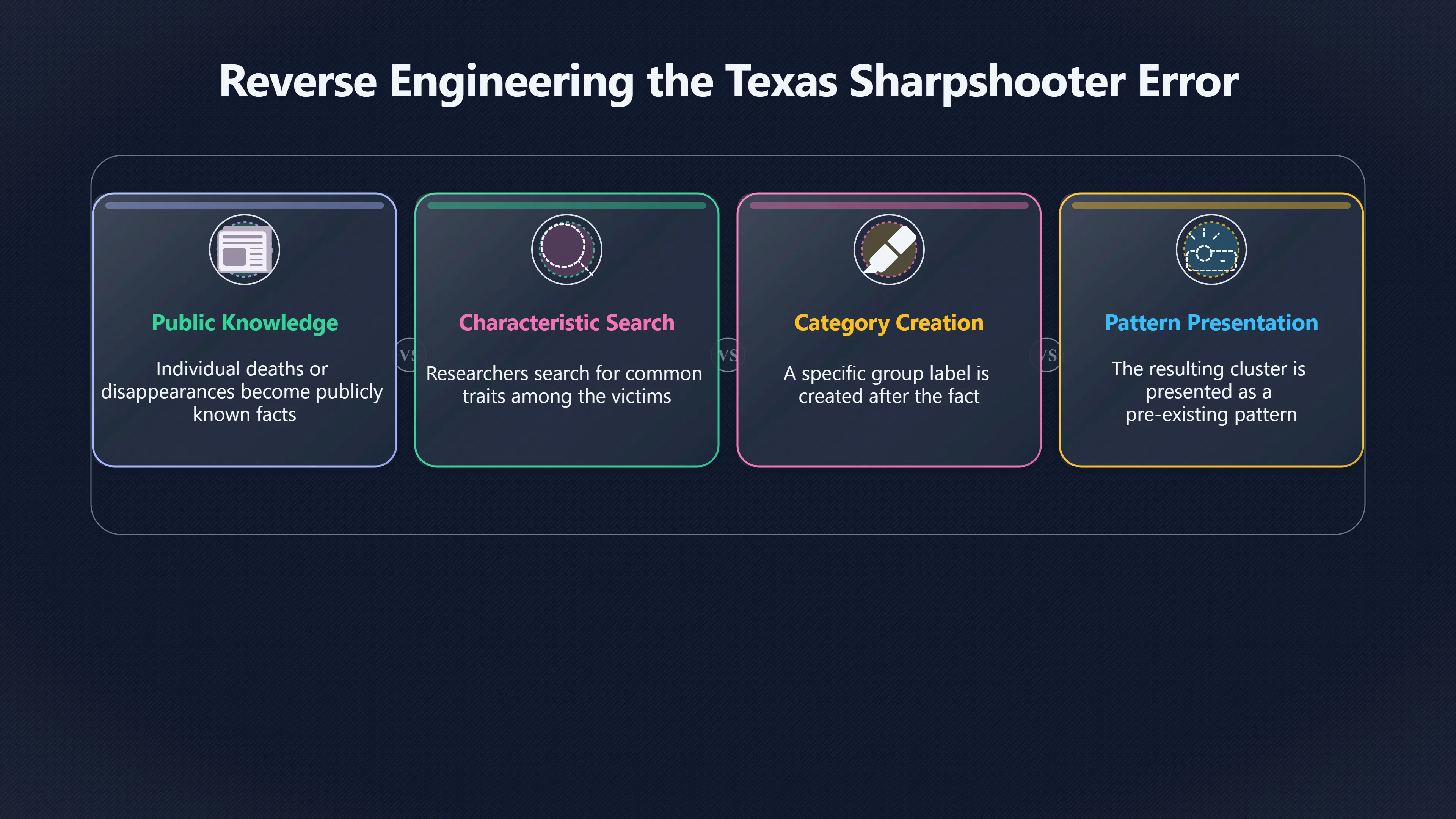
Applied to dead-scientist narratives, the process often unfolds in reverse order:
- Several deaths, disappearances or tragedies become publicly known.
- Researchers or online commentators search for common characteristics.
- A category is created after the fact, such as “scientists connected to advanced propulsion”, “researchers with UFO knowledge”, or “people linked to secret aerospace programmes”.
- The resulting cluster is presented as though it had been identified before the events occurred.
The crucial issue is that countless alternative groupings could also have been created. A person could just as easily construct lists of scientists who lived long lives, researchers who changed employers, engineers involved in classified projects who died of natural causes, or aerospace workers who experienced unrelated accidents. The selected cluster gains attention precisely because it is unusual and emotionally striking.[wikipedia.org]WikipediaTexas sharpshooter fallacyTexas sharpshooter fallacy
How Post Hoc Boundaries Create Apparent Patterns
The power of the Texas Sharpshooter Error comes from flexibility. The more freedom there is to define a category after events are known, the easier it becomes to produce an apparently meaningful pattern.
In UFO and antigravity-related death lists, boundaries are often adjusted in ways that make the cluster appear stronger:
- Including both scientists and engineers.
- Including military officers with technical backgrounds.
- Including current employees, contractors and retirees.
- Mixing deaths, disappearances, suicides, accidents and homicides.
- Expanding the timeframe from months to years.
- Including individuals with only indirect links to the claimed research area.
Each addition may appear reasonable on its own. However, when multiple flexible choices are combined, the final list can reflect the selector’s preferences more than any underlying phenomenon.[Wikipedia]WikipediaTexas sharpshooter fallacyTexas sharpshooter fallacy
This is closely related to what psychologists call the clustering illusion: the human tendency to see meaningful concentrations in random or weakly related events. Once a cluster is assembled, similarities become highly visible while differences fade into the background.[wikipedia.org]WikipediaTexas sharpshooter fallacyTexas sharpshooter fallacy
A striking feature of many “dead scientist” compilations is that they frequently combine people who worked in different disciplines, lived in different countries, died under different circumstances and had no documented interactions with one another. The apparent connection arises from the category imposed afterwards rather than from independently established links between the cases.
Why Changing Case Rules Changes the Story
One way to identify the Texas Sharpshooter Error is to ask what happens when the selection rules change.
Suppose a list initially contains ten individuals described as scientists connected to advanced aerospace work. Several questions immediately arise:
- Why were those ten included instead of twenty or fifty?
- Why were deaths included but not living colleagues?
- Why were disappearances counted but not resolved missing-person cases?
- Why were some institutional connections considered relevant while others were ignored?
- Would the pattern still appear unusual if the population were defined before examining outcomes?
The answers often reveal how much the apparent cluster depends on subjective choices.
A useful real-world parallel emerged in recent discussions about alleged “missing scientists” connected to sensitive research. Sceptics noted that many cited cases involved different causes, different timelines and varying degrees of connection to the claimed subject matter. Critics argued that investigators were effectively searching through a large pool of deaths and disappearances and then retrospectively constructing a category around those that seemed most intriguing. Commentators described the process as finding “patterns in random noise” rather than uncovering a demonstrable network of linked events.[Wikipedia]WikipediaMissing scientists conspiracy theoryMissing scientists conspiracy theory
The important methodological point is not whether every individual case has been fully explained. The point is that altering inclusion criteria can dramatically change the size, composition and apparent significance of the cluster.

Why Large Scientific Communities Produce Striking Coincidences
The Texas Sharpshooter Error becomes especially persuasive when applied to large populations.
Scientific, engineering, defence and aerospace communities collectively contain hundreds of thousands of people. Across such populations, rare events are guaranteed to occur. Deaths, accidents, illnesses, disappearances and crimes will happen even if no common cause exists.
Persi Diaconis and Frederick Mosteller’s “law of truly large numbers” captures this principle succinctly: with a sufficiently large sample, seemingly extraordinary coincidences become expected. Events that appear astonishing when viewed individually may become statistically unsurprising when viewed against the size of the underlying population.[stat.berkeley.edu]stat.berkeley.eduMethods for Studying CoincidencesSuccinctly put, the law of truly large numbers states: With a large enough sample, any outrageous thing is likely to happen.Read more…
This matters because dead-scientist narratives rarely begin with the entire population and work downward. Instead, they often begin with unusual outcomes and work backward to find shared characteristics. That reversal is precisely what creates vulnerability to the Texas Sharpshooter Error.[Wikipedia]WikipediaTexas sharpshooter fallacyTexas sharpshooter fallacy
Checks That Separate Clusters from Coincidences
A genuine cluster investigation attempts to prevent post hoc pattern creation by establishing rules before examining outcomes. Public-health and epidemiological guidance emphasises defining assumptions, populations and methods in advance rather than allowing the observed cases to dictate the analytical framework.[Wikipedia]WikipediaTexas sharpshooter fallacyTexas sharpshooter fallacy
Several questions are particularly useful when evaluating claims about suspicious scientist deaths:
Was the population defined first?
A strong analysis begins with a clearly specified group—such as all employees of a particular laboratory during a defined period—and then measures outcomes within that group.
A weak analysis begins with a collection of unusual outcomes and only later decides who belongs in the category.
Is there a baseline rate?
Without knowing how many deaths, accidents or disappearances would normally be expected, it is impossible to determine whether a cluster is unusual.
Are the links independent of the outcome?
If people are considered connected only after something bad happens to them, the selection process itself may be creating the pattern.
Do the cases share evidence beyond category labels?
A common employer, research interest or security clearance is much weaker evidence than documented communications, shared threats, common suspects, verified motives or direct operational links.
The Significance of the Error in UFO-Related Death Narratives
The Texas Sharpshooter Error does not automatically disprove claims about any particular death, disappearance or suspicious event. Individual cases may still deserve investigation on their own merits. What the error challenges is the inference that a list of cases becomes persuasive simply because it forms a cluster.
In UFO and antigravity death narratives, the mechanism is often subtle. A collection of real tragedies is assembled, similarities are emphasised, differences are minimised, and the resulting pattern appears stronger than it would under pre-defined analytical rules. The more flexible the category, the greater the risk that the apparent pattern reflects selection choices rather than an underlying conspiracy.[wikipedia.org]WikipediaTexas sharpshooter fallacyTexas sharpshooter fallacy
Understanding this mechanism helps explain why some dead-scientist lists can look compelling at first glance while remaining weak as evidence of a coordinated campaign. The appearance of a target is not necessarily evidence that a target existed before the shots were fired.[Fallacy Files]fallacyfiles.orgFallacy FilesThe Texas Sharpshooter FallacyThis fallacy lives up to its striking name because the Texas sharpshooter took a random cluste…
Amazon book picks
Further Reading
Books and field guides related to When the Target Is Drawn Afterward. Use these as the next step if you want deeper reading beyond the article.
The Art of Statistics
Explains how apparent patterns emerge and how to test whether they are meaningful.
Fooled by Randomness
Rating: 4.0/5 from 15 Google Books ratings
Directly addresses false pattern detection and post hoc storytelling.
How to Lie with Statistics
Helps readers understand how selective presentation can create misleading impressions.
The Improbability Principle
Shows why clusters and unlikely-looking events often arise naturally.
eBay marketplace picks
Marketplace Samples
Live-tested eBay searches with available results related to this page.



Endnotes
1.
Source: Wikipedia
Title: Texas sharpshooter fallacy
Link:https://en.wikipedia.org/wiki/Texas_sharpshooter_fallacy
2.
Source: yourlogicalfallacyis.com
Title: This ‘false cause’ fallacy is coined after a marksman shooting
Link:https://yourlogicalfallacyis.com/the-texas-sharpshooter
Source snippet
Your logical fallacy is the texas sharpshooterYou cherry-picked a data cluster to suit your argument, or found a pattern to fit a presump...
3.
Source: Wikipedia
Title: Missing scientists conspiracy theory
Link:https://en.wikipedia.org/wiki/Missing_scientists_conspiracy_theory
4.
Source: stat.berkeley.edu
Title: Methods for Studying Coincidences
Link:https://www.stat.berkeley.edu/~aldous/157/Papers/diaconis_mosteller.pdf
Source snippet
Succinctly put, the law of truly large numbers states: With a large enough sample, any outrageous thing is likely to happen.Read more...
5.
Source: Wikipedia
Link:https://de.wikipedia.org/wiki/Zielscheibenfehler
Source snippet
ZielscheibenfehlerDer Zielscheibenfehler, englisch Texas sharpshooter fallacy, ist ein Begriff aus der Methodenlehre der empirischen W...
6.
Source: fallacyfiles.org
Link:https://www.fallacyfiles.org/texsharp.html
Source snippet
Fallacy FilesThe Texas Sharpshooter FallacyThis fallacy lives up to its striking name because the Texas sharpshooter took a random cluste...
7.
Source: logicallyfallacious.com
Link:https://www.logicallyfallacious.com/logicalfallacies/Texas-Sharpshooter-Fallacy
Source snippet
Texas Sharpshooter Fallacy(also known as: clustering illusion). Description: Ignoring the difference while focusing on the similarities...
Additional References
8.
Source: everydayconcepts.io
Link:https://everydayconcepts.io/texas-sharpshooter-fallacy
Source snippet
Texas Sharpshooter FallacyTexas Sharpshooter Fallacy. Cherry-picking data clusters to suit an argument while ignoring the data that doesn...
9.
Source: fastercapital.com
Link:https://fastercapital.com/topics/understanding-the-texas-sharpshooter-fallacy.html/1
Source snippet
Understanding The Texas Sharpshooter FallacyThe Texas Sharpshooter Fallacy is a logical fallacy that occurs when someone selectively choo...
10.
Source: mathworld.wolfram.com
Link:https://mathworld.wolfram.com/LawofTrulyLargeNumbers.html
Source snippet
of Truly Large Numbers -- from Wolfram MathWorldLaw of Truly Large Numbers: With a large enough sample, any outrageous thing is likely to...
11.
Source: researchgate.net
Title: 330283301 The Texas Sharpshooter Fallacy
Link:https://www.researchgate.net/publication/330283301_The_Texas_Sharpshooter_Fallacy
Source snippet
(PDF) The Texas Sharpshooter Fallacy30 Apr 2026 — Some are dead... Jung was intrigued from early in his career with coincidences, especi...
12.
Source: philosophy.stackexchange.com
Title: what is the texas sharpshooter fallacy
Link:https://philosophy.stackexchange.com/questions/73602/what-is-the-texas-sharpshooter-fallacy
Source snippet
is the Texas sharpshooter fallacy?16 Jun 2020 — The Texas sharpshooter fallacy is an informal fallacy which is committed when differences...
13.
Source: scribd.com
Link:https://www.scribd.com/document/661859917/Texas-Sharpshooter-Fallacy
Source snippet
ored, but similarities are overemphasized.Read more...
14.
Source: reddit.com
Title: The Texas sharpshooter fallacy
Link:https://www.reddit.com/r/wikipedia/comments/1mkbmh/the_texas_sharpshooter_fallacy_a_cognitive_bias/
Source snippet
A cognitive bias where...The Texas sharpshooter fallacy - A cognitive bias where you look at similarities in unrelated pieces of informa...
15.
Source: youarenotsosmart.com
Title: the texas sharpshooter fallacy
Link:https://youarenotsosmart.com/2010/09/11/the-texas-sharpshooter-fallacy/
Source snippet
11 Sept 2010 — One of the reasons scientists form a hypothesis and then try to disprove it with new research is to avoid the Texas Sharps...
16.
Source: skepdic.com
Title: Texas sharpshooter fallacy
Link:https://skepdic.com/texas.html
Source snippet
Texas-sharpshooter fallacy is the name epidemiologists give to the clustering illusion. Politicians, lawyers and some scientists tend to...
17.
Source: youtube.com
Link:http://www.youtube.com/watch?v=0mCDjwfhQ10
Source snippet
Two more deaths linked to missing scientists mystery; FBI investigates | Katie Pavlich Tonight...
Topic Tree