Within Clusters
A Checklist for Suspicious Death Clusters
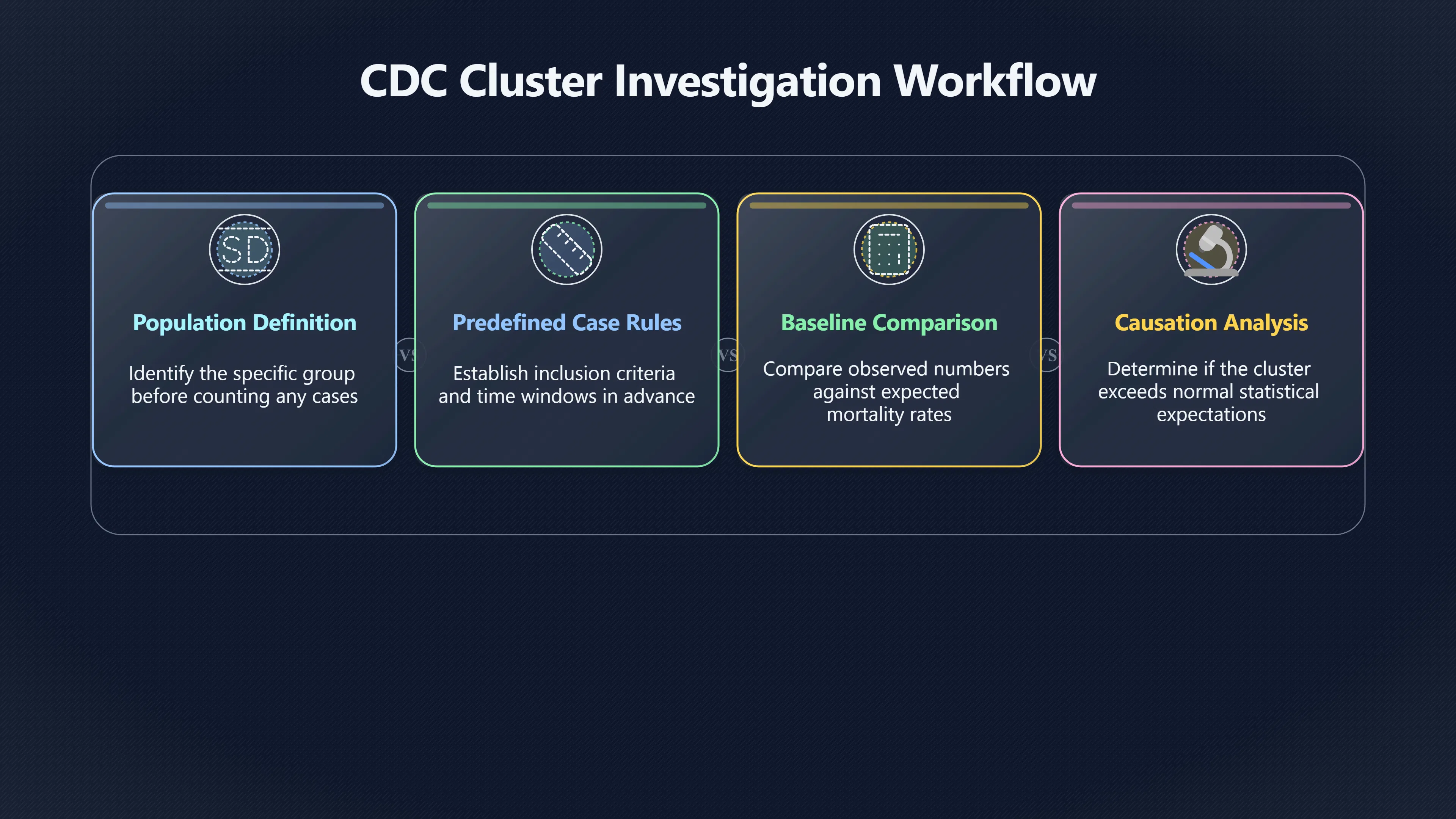
Public-health cluster principles offer a practical checklist for testing whether a list was built fairly.
On this page
- Define the population before counting cases
- Set case rules and time windows in advance
- Compare the observed list with expected rates
Page outline Jump by section
Introduction
Claims about suspicious deaths among UFO researchers, antigravity theorists, aerospace engineers, or defence scientists often rely on lists of names that appear unusually concentrated in time or profession. The central question is not whether any individual case is tragic or unresolved, but whether the collection of cases represents a genuine cluster that requires a common explanation. Public-health investigators face similar questions when communities report apparent cancer clusters or other unusual patterns of illness. The methods developed by the U.S. Centers for Disease Control and Prevention (CDC) provide a practical framework for testing whether a claimed cluster has been assembled fairly or whether it may be the product of selective counting.[CDC]cdc.govRead moreGuidelines for Examining Unusual Patterns of Cancer and…Apr 12, 2024 — The revised guidelines update the 2013 archived Morbidity an…
 Applied to UFO-related death claims, CDC-style cluster rules do not automatically disprove conspiracy theories. Instead, they require investigators to define the population, establish case criteria before counting, and compare the observed number of cases against an expected baseline. These steps help distinguish a potentially meaningful pattern from one that merely appears suspicious after the fact.[CDC]cdc.govGuidelines for Investigating Clusters of Health EventsThe recommended approach is a four-stage process: initial response, assessment…
Define the Population Before Counting Cases
The first CDC principle is deceptively simple: determine who belongs in the population before examining whether a cluster exists. In public-health investigations, a cluster cannot be evaluated without knowing the group from which cases arose. A count of illnesses means little unless it can be compared with the size and characteristics of the population at risk.[Restored CDC]restoredcdc.orgOne of every four deaths in the United States is…
Applied to UFO and antigravity death narratives, this requirement immediately exposes a common weakness. Lists circulated in books, documentaries, and online discussions often combine people from very different backgrounds:
- Aerospace engineers.
- Defence contractors.
- Physicists.
- Computer scientists.
- Military personnel.
- Individuals with only indirect links to UFO subjects.
Without a predefined population, the apparent cluster becomes difficult to interpret. A list of twenty deaths sounds alarming, but its significance depends on whether those twenty came from a population of fifty people, five thousand people, or hundreds of thousands of scientists and engineers over several decades.
The CDC’s approach emphasises that the denominator matters as much as the numerator. A cluster claim based only on selected cases provides no way to determine whether the observed number is unusual.[Restored CDC]restoredcdc.orgOne of every four deaths in the United States is…
Set Case Rules and Time Windows in Advance
A second CDC rule is that investigators should establish definitions, assumptions, and methods before deciding which cases count. This requirement exists to prevent what epidemiologists call the Texas Sharpshooter fallacy: noticing a pattern first and then drawing boundaries around it afterwards.[cdc.gov]cdc.govAPPENDIX C: Statistical and Epidemiologic Approachesby C Interval — However, to avoid the "Texas Sharpshooter fallacy" (i.e., a situat…
The classic UFO-death compilation often illustrates exactly the problem that CDC guidance warns against. Case lists may include:
- Confirmed homicides.
- Apparent suicides.
- Accidents.
- Natural deaths.
- Missing-person cases.
- Deaths occurring decades apart.
The list may also expand or contract depending on the argument being made. If a death appears suspicious, the individual’s connection to UFO research may be emphasised. If another scientist worked in a similar field but died of recognised natural causes, that person may be omitted.
CDC guidance specifically warns against defining the affected group after the cases have already been selected. In cluster investigations, investigators are expected to decide in advance what qualifies as a case, what geographic or organisational boundaries apply, and what time period will be analysed.[CDC]cdc.govAPPENDIX C: Statistical and Epidemiologic Approachesby C Interval — However, to avoid the "Texas Sharpshooter fallacy" (i.e., a situat…
For UFO-related claims, equivalent questions would include:
- Does the study include only researchers directly involved in propulsion projects?
- Are contractors counted?
- Are retirees included?
- What period is being examined: one year, five years, or thirty years?
- Do all causes of death qualify, or only violent deaths?
Without predefined rules, a list can grow until it appears statistically striking regardless of whether a genuine cluster exists.
Compare the Observed List With Expected Rates
Perhaps the most important CDC principle is that unusual events must be compared with expected rates rather than judged by intuition alone. Public-health agencies investigate whether the observed number of cases exceeds what would normally occur in a comparable population.[restoredcdc.org]restoredcdc.orgOne of every four deaths in the United States is…
This step is frequently absent from UFO death narratives.
Suppose a claim identifies fifteen scientists connected to advanced aerospace research who died over ten years. Whether that number is remarkable depends on several factors:
- The size of the relevant workforce.
- The age distribution of that workforce.
- Background mortality rates.
- Rates of accidents, suicides, and homicides in similar populations.
- The length of the observation period.
A group containing thousands of middle-aged and older technical professionals would be expected to experience a certain number of deaths each year even if no conspiracy existed. CDC cluster investigations therefore begin by estimating what would normally be expected before concluding that an excess has occurred.[Restored CDC]restoredcdc.orgOne of every four deaths in the United States is…
The same logic applies to disappearances or violent deaths. If investigators cannot show that the observed number substantially exceeds expected levels, the existence of a statistically meaningful cluster remains unproven.
Why Apparent Clusters Often Survive Without Statistical Support
One reason UFO death lists remain persuasive is that humans naturally notice dramatic events and ignore ordinary ones. Public-health researchers have long recognised that random events frequently form patterns that look meaningful in hindsight. Cluster investigations are therefore designed to guard against post-hoc interpretation.[CDC]cdc.govGuidelines for Investigating Clusters of Health EventsThe recommended approach is a four-stage process: initial response, assessment…
The Texas Sharpshooter problem is especially relevant. A researcher may begin with several deaths already known to be unusual and then search for common characteristics linking them. Once enough shared traits are found—employment in aerospace, security clearances, interest in unconventional propulsion, or association with a defence laboratory—the collection can appear far more connected than it actually is. CDC guidance explicitly warns that defining the affected area or group after identifying the cases can create the illusion of a cluster.[CDC]cdc.govAPPENDIX C: Statistical and Epidemiologic Approachesby C Interval — However, to avoid the "Texas Sharpshooter fallacy" (i.e., a situat…
Statistical literature on cluster investigations similarly notes that apparent concentrations often arise simply because large populations generate coincidences. When many individuals are observed over long periods, some uncommon events will naturally occur close together in time or within professional networks.[PMC]pmc.ncbi.nlm.nih.govA causal inference framework for cancer cluster investigations…by RC Nethery · 2020 · Cited by 9 — The most prominent statistical l…
A Practical Checklist for Suspicious Death Clusters
Using CDC-style principles, readers evaluating a UFO-related death list can ask three core questions:
- Was the population defined before the cases were counted? If not, the cluster may be based on selective inclusion.
- Were case definitions and time windows established in advance? If criteria changed after the cases were known, the apparent pattern may be exaggerated.
- Was the observed number compared with an expected baseline? If no expected rate was calculated, there is no reliable way to know whether the cluster is unusual.
Additional supporting questions include:
- Are the cases linked by evidence or only by occupation?
- Are ordinary deaths included as well as suspicious ones?
- Would the same method identify comparable clusters in unrelated scientific fields?
- Can the pattern be reproduced by independent investigators using the same rules?
These questions do not resolve individual mysteries. A specific death may remain unexplained, and some cases may still merit closer scrutiny. The value of the CDC framework is that it separates the evaluation of individual incidents from the stronger claim that a coordinated pattern has been demonstrated.[cdc.gov]cdc.govRead moreGuidelines for Examining Unusual Patterns of Cancer and…Apr 12, 2024 — The revised guidelines update the 2013 archived Morbidity an…

What the CDC Framework Can and Cannot Show
Cluster-investigation methods are designed to determine whether a reported pattern exceeds what would normally be expected, not to identify perpetrators or motives. Even a statistically significant cluster would not automatically prove assassination, suppression of research, or intelligence involvement. Conversely, failure to demonstrate a statistical cluster does not prove that every individual case has an ordinary explanation.[CDC Stacks]stacks.cdc.govCDC StacksInvestigating cancer clusters and unusual patterns of cancerThe revised guidelines propose an approach to identifying and inves…
Within the debate over alleged deaths linked to UFO or antigravity research, the CDC approach serves as a disciplined first filter. Before asking whether a hidden cause exists, investigators must first establish that there is a genuine cluster to explain. Only after the population, case definitions, time window, and expected rates have been rigorously specified does the question of causation become meaningful.[CDC]cdc.govGuidelines for Investigating Clusters of Health EventsThe recommended approach is a four-stage process: initial response, assessment…
Amazon book picks
Further Reading
Books and field guides related to A Checklist for Suspicious Death Clusters. Use these as the next step if you want deeper reading beyond the article.
How to Lie with Statistics
Explains how selective counting, biased samples, and misleading presentations can create false impressions of clusters or patterns.
The Drunkard's Walk
Rating: 4.5/5 from 7 Google Books ratings
Helps readers understand coincidence, randomness, and why apparent patterns often emerge by chance.
Thinking, Fast and Slow
Covers cognitive biases that influence how people interpret suspicious events and perceived clusters.
Bad Science
Demonstrates evidence-based evaluation of claims and the importance of proper comparison groups and statistical reasoning.
eBay marketplace picks
Marketplace Samples
Live-tested eBay searches with available results related to this page.


Endnotes
1.
Source: cdc.gov
Title: Read more
Link:https://www.cdc.gov/cancer-environment/php/guidelines/index.html
Source snippet
Guidelines for Examining Unusual Patterns of Cancer and...Apr 12, 2024 — The revised guidelines update the 2013 archived Morbidity an...
2.
Source: cdc.gov
Link:https://www.cdc.gov/mmwr/preview/mmwrhtml/rr6208a1.htm
Source snippet
State and local health departments can use these guidelines to develop a systematic approach to responding to...Read more...
3.
Source: cdc.gov
Link:https://www.cdc.gov/mmwr/preview/mmwrhtml/00001797.htm
Source snippet
Guidelines for Investigating Clusters of Health EventsThe recommended approach is a four-stage process: initial response, assessment...
4.
Source: cdc.gov
Link:https://www.cdc.gov/mmwr/preview/mmwrhtml/rr6208a4.htm
Source snippet
APPENDIX C: Statistical and Epidemiologic Approachesby C Interval — However, to avoid the "Texas Sharpshooter fallacy" (i.e., a situat...
5.
Source: restoredcdc.org
Link:https://restoredcdc.org/www.cdc.gov/mmwr/preview/mmwrhtml/rr6208a1.htm%3Fs_cid%3Drr6208a1_w
Source snippet
One of every four deaths in the United States is...
6.
Source: cdc.gov
Title: About Unusual Patterns of Cancer
Link:https://www.cdc.gov/cancer-environment/about/index.html
Source snippet
6 May 2026 — Some unusual patterns of cancer are considered a cancer cluster. A cancer cluster is defined as a greater than expected numb...
Published: May 2026
7.
Source: assets.publishing.service.gov.uk
Link:https://assets.publishing.service.gov.uk/media/5c752d1eed915d3554c293fe/INIDC_guidance_v1.0.pdf
8.
Source: healthy.arkansas.gov
Title: Guidelines Chronic Disease Clusters
Link:https://healthy.arkansas.gov/wp-content/uploads/GuidelinesChronicDiseaseClusters.pdf
Source snippet
Arkansas Department of HealthGuidelines for Investigating Clusters of Chronic Diseases27 Sept 2013 — However, to avoid the "Texas Sharpsh...
9.
Source: cdc.gov
Title: statistical considerations
Link:https://www.cdc.gov/cancer-environment/php/guidelines/statistical-considerations.html
Source snippet
Appendix A: Statistical Considerations | Unusual Cancer...6 May 2026 — This section provides general guidance regarding epidemiologic an...
Published: May 2026
10.
Source: pmc.ncbi.nlm.nih.gov
Title: PMCAn Update on Cancer Cluster Activities at the Centers
Link:https://pmc.ncbi.nlm.nih.gov/articles/PMC1797849/
Source snippet
by BS Kingsley · 2006 · Cited by 72 — In 1990 the CDC published the “Guidelines for Investigating Clusters of Health Events,” in which...
11.
Source: stacks.cdc.gov
Link:https://stacks.cdc.gov/view/cdc/122695
Source snippet
Guidelines for examining unusual patterns of cancer and...by SL Foster · 2022 · Cited by 6 — The guidelines presented here update...
12.
Source: cdc.gov
Link:https://www.cdc.gov/cancer-environment/php/guidelines/summary.html
Source snippet
Summary | Unusual Cancer PatternsApr 12, 2024 — The revised guidelines propose an approach to identifying and investigating unusual patte...
13.
Source: stacks.cdc.gov
Link:https://stacks.cdc.gov/view/cdc/122696
Source snippet
CDC StacksInvestigating cancer clusters and unusual patterns of cancerThe revised guidelines propose an approach to identifying and inves...
14.
Source: atsdr.cdc.gov
Title: cancer cluster guidelines
Link:https://www.atsdr.cdc.gov/peer-review-agenda/php/reports/cancer-cluster-guidelines.html
Source snippet
for Examining Unusual Patterns of Cancer and...Sep 2, 2024 — This ATSDR report shares the guidelines for examining unusual patterns of c...
15.
Source: cdc.gov
Link:https://www.cdc.gov/index.html
Source snippet
Centers for Disease Control and PreventionCDC is the nation's leading science-based, data-driven, service organization that protects...
16.
Source: cdc.gov
Title: responding community concerns
Link:https://www.cdc.gov/cancer-environment/php/guidelines/responding-community-concerns.html
Source snippet
Responding to Community Concerns about Unusual...Apr 12, 2024 — Listening skills are crucial when community members first contact health...
17.
Source: stacks.cdc.gov
Link:https://stacks.cdc.gov/view/cdc/22138
Source snippet
State and local health departments can use these guidelines to develop a systematic approach to responding to...Read more...
18.
Source: people.com
Link:https://people.com/cdc-begins-enhanced-ebola-screening-at-atlanta-airport-11983075
19.
Source: healthy.arkansas.gov
Title: FINAL ADH Chronic Disease Pattern Examination Protocol
Link:https://healthy.arkansas.gov/wp-content/uploads/FINAL_ADH-Chronic-Disease-Pattern-Examination-Protocol.pdf
Source snippet
for Investigating Clusters of Chronic Disease and...CDC's ATSDR guideline defines a cancer cluster as: “A greater than expected number o...
20.
Source: pmc.ncbi.nlm.nih.gov
Link:https://pmc.ncbi.nlm.nih.gov/articles/PMC8276584/
Source snippet
A causal inference framework for cancer cluster investigations...by RC Nethery · 2020 · Cited by 9 — The most prominent statistical l...
21.
Source: pubmed.ncbi.nlm.nih.gov
Link:https://pubmed.ncbi.nlm.nih.gov/24067663/
Source snippet
State and local health departments can use these guidelines to develop a systematic approach to responding to...Read more...
22.
Source: health.nsw.gov.au
Link:https://www.health.nsw.gov.au/environment/Publications/cancer-cluster-guidelines.PDF
Source snippet
to cancer clusters in NSWHowever, it is important to avoid the 'Texas sharpshooter fallacy'. In cancer clusters, this fallacy may occur w...
23.
Source: Wikipedia
Title: Centers for Disease Control and Prevention
Link:https://en.wikipedia.org/wiki/Centers_for_Disease_Control_and_Prevention
Source snippet
Centers for Disease Control and PreventionThe agency's main goal is the protection of public health and safety through the control and...
Additional References
24.
Source: idcancer.org
Link:https://idcancer.org/pdfs/resources/cancer-clusters/Investigation_of_Non-infectious_Disease_Clusters_2023.pdf
Source snippet
Investigation of Non-infectious Disease ClustersDuring the course of an investigation, lower than expected rates of cancer may be identif...
25.
Source: researchgate.net
Link:https://www.researchgate.net/publication/286597039_Investigating_Suspected_Cancer_Clusters_and_Responding_to_Community_Concerns_Guidelines_from_CDC_and_the_Council_of_State_and_Territorial_Epidemiologists
Source snippet
Investigating Suspected Cancer Clusters and Responding...Mar 2, 2026 — These guidelines utilize a four-step approach (initial response...
26.
Source: astho.org
Title: recommendations updating cdc cste cancer cluster investigation guidelines
Link:https://www.astho.org/topic/brief/recommendations-updating-cdc-cste-cancer-cluster-investigation-guidelines/
Source snippet
Recommendations for Updating CDC/CSTE Cancer...Oct 14, 2022 — Expand guidance to address health equity challenges in cancer cluster inve...
27.
Source: researchgate.net
Link:https://www.researchgate.net/publication/4993120_Disease_clusters_Should_they_be_investigated_and_if_so_when_and_how
Source snippet
nt for detailed epidemiological follow-up (Neutra 1990; Elliott and Wakefield 2001).Read more...
28.
Source: naccho.org
Link:https://www.naccho.org/resource-hub-articles/investigating-suspected-cancer-clusters-and-responding-to-community-concerns-guidelines-from-cdc-an
Source snippet
atic approach to responding to community concerns regarding cancer clusters.Read more...
29.
Source: idcancer.org
Link:https://idcancer.org/pdfs/resources/cancer-clusters/CAWG_Worksite_Cancer_Cluster_Protocol_20150216.pdf
Source snippet
Investigation of Non-infectious Disease Clusters in...• “Guidelines for Investigating Clusters of Health Events” (MMWR July 27, 1990/Vol...
Published: July 27, 1990
30.
Source: open.alberta.ca
Title: investigation clusters guidelines 2011
Link:https://open.alberta.ca/dataset/2f113033-825d-4a24-a045-6bed269fe841/resource/797abfa8-cc8c-4bbc-9aa3-b52693576551/download/investigation-clusters-guidelines-2011.pdf
Source snippet
Texas sharpshooter fallacy, finding a cluster in randomness because the area ex...
31.
Source: nciph.sph.unc.edu
Title: 5 4Cluster Investigations slides.ppt
Link:https://nciph.sph.unc.edu/focus/vol5/issue4/5-4ClusterInvestigations_slides.ppt
Source snippet
"unc.eduSlideCDC. Guidelines for investigating clusters of health events. MMWR Morb Mortal Wkly Rep. 1990;39(RR-11):1-16. [http://www.cdc.g..."](http://www.cdc.g...")...
32.
Source: youtube.com
Link:https://www.youtube.com/watch?v=_Gq37QqnPlM
Source snippet
Missing scientists: Body found, new timelines & more updates | Backscroll...
33.
Source: youtube.com
Title: UFOs and missing scientists: Are conspiracy theories mainstream?
Link:https://www.youtube.com/watch?v=H_dDQ-IqnT0
Source snippet
Missing U.S. Scientist Found Dead: Mystery Around UFO-Linked Researchers Deepens | GRAVITAS...
Topic Tree