Within Sensitive Labs
How Proximity Turns Tragedy Into Theory
Suspicion often grows from proximity, not proof, when a tragedy happens near a classified scientific workplace.
On this page
- The association chain from lab work to alleged motive
- Why coincidence feels stronger around prestigious institutions
- How to separate proximity from causal evidence
Page outline Jump by section
Introduction
In stories about UFO research, antigravity projects and allegedly silenced scientists, one of the most powerful narrative engines is not direct evidence but proximity. A researcher works at a classified laboratory, a defence contractor or a national-security facility; later, a death, disappearance or unexplained personal crisis occurs; the workplace connection then becomes the foundation for a theory that the event was not accidental but part of a cover-up.
 This mechanism is important because it often operates even when there is little or no evidence connecting the tragedy to the person’s work. The mere fact that a laboratory is secretive, prestigious or associated with sensitive research can make coincidence feel suspicious. In recent “missing scientists” narratives, online discussions frequently treated links to institutions such as national laboratories, aerospace programmes or defence-related research as evidence of motive, even though reporting repeatedly noted that no public evidence had established a coordinated plot connecting the cases.[AP News]apnews.comAP NewsHow conspiracy theories about missing or dead scientists…April 24, 2026 — 24 Apr 2026 — But so far no evidence has been found t…
The Association Chain From Lab Work to Alleged Motive
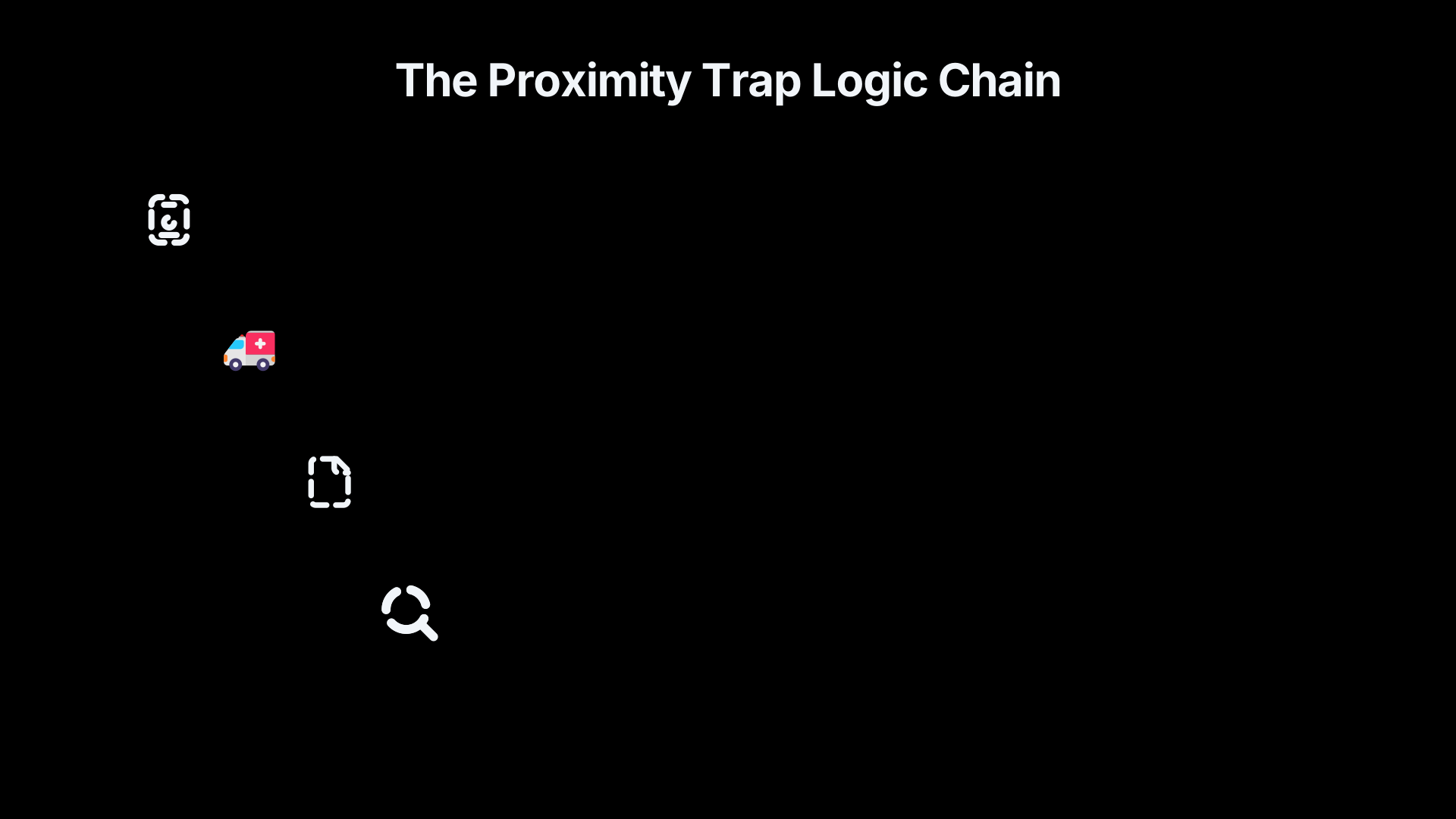
The proximity trap usually follows a predictable sequence.
First, a person is identified as having worked at a sensitive institution. The institution may have classified programmes, security clearances or a historical association with advanced aerospace, nuclear or defence research.
Second, an unusual event occurs. This may be a death, disappearance, accident, illness or unresolved investigation. The event itself may have no demonstrated connection to the workplace.
Third, observers infer hidden knowledge. Because the workplace handles classified information, the individual is assumed to have known something exceptionally important.
Finally, a motive is constructed. If the individual supposedly possessed sensitive knowledge, then the tragedy is reinterpreted as evidence that someone wanted that knowledge concealed.
The crucial step is that the motive is often inferred from the workplace connection rather than demonstrated through evidence. The chain moves from “worked near secrets” to “must have known secrets” to “must have been targeted because of those secrets”. Each step can sound plausible, but each requires additional evidence that is frequently absent.
This pattern appeared in discussions surrounding recent claims about dead or missing scientists. Public speculation often centred on institutional affiliations with organisations linked to aerospace, nuclear research or national security, while investigators and journalists repeatedly noted that no established evidentiary link connected the cases into a single conspiracy.[apnews.com]apnews.comAP NewsHow conspiracy theories about missing or dead scientists…April 24, 2026 — 24 Apr 2026 — But so far no evidence has been found t…
Why Classified Laboratories Magnify Suspicion
A tragedy occurring near an ordinary workplace may attract local attention. The same tragedy involving a classified laboratory often attracts national or international speculation.
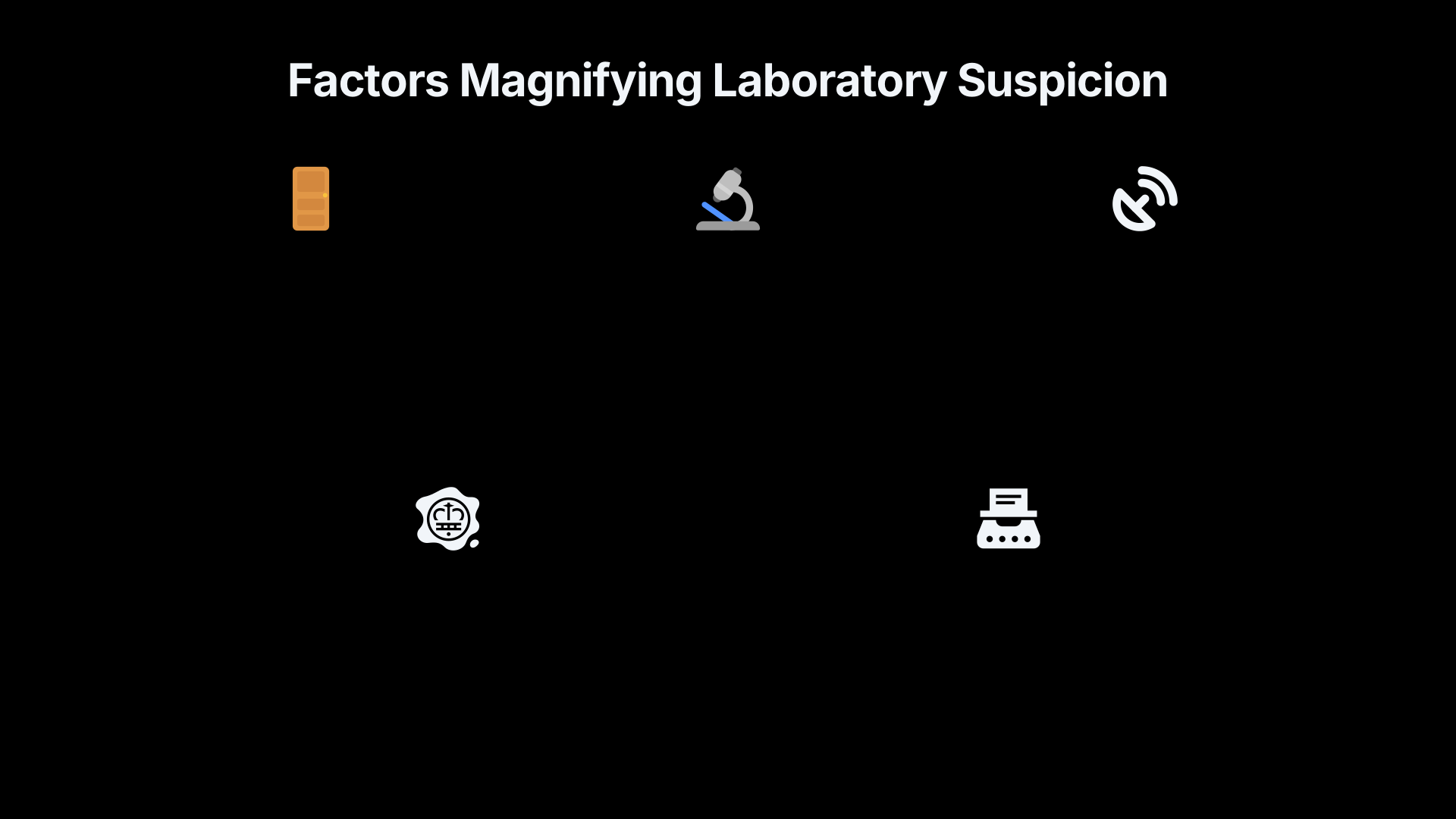
Several features of such institutions contribute to this effect.
Real secrecy creates information gaps. Classified facilities cannot publicly discuss many projects, personnel assignments or operational details. When information is unavailable, observers may assume the missing information is incriminating rather than merely restricted.
Prestige implies importance. Laboratories associated with advanced physics, aerospace systems or nuclear technology carry symbolic weight. The public may assume every employee has access to extraordinary knowledge, even though large research institutions include people with very different roles and levels of access.
Historical myths accumulate. Certain facilities become linked to decades of speculation about UFOs, exotic propulsion or hidden government programmes. Once a laboratory acquires that reputation, unrelated events occurring nearby are more easily absorbed into existing narratives.
National-security language sounds inherently dramatic. Terms such as “classified”, “clearance”, “special access” and “defence research” naturally suggest hidden activity. In public discourse, these labels can function almost as evidence substitutes, encouraging suspicion even when they reveal little about what a person actually did.
The result is that the laboratory becomes a narrative shortcut. Instead of proving motive, it supplies an atmosphere in which motive feels obvious.
Why Coincidence Feels Less Plausible Around Prestigious Institutions
Human beings are naturally inclined to search for patterns, especially when events are emotionally significant or difficult to explain.
Research in psychology has repeatedly linked conspiracy beliefs to what scholars call illusory pattern perception: the tendency to perceive meaningful connections between events that may not actually be causally related. Studies have found that people who more readily detect patterns in randomness are also more likely to endorse conspiracy explanations.[nih.gov]pmc.ncbi.nlm.nih.govConnecting the dots: Illusory pattern perception predicts belief…by JW van Prooijen · 2017 · Cited by 459 — We conclude that illuso…
Around elite scientific institutions, several psychological effects reinforce this tendency.
The “There Must Be More to It” Effect
When a person connected to advanced research dies unexpectedly, many people find mundane explanations emotionally unsatisfying. The greater the perceived importance of the individual or institution, the stronger the expectation that an extraordinary cause must exist.
A death involving a laboratory physicist may therefore seem less likely to be random than an identical death involving someone without a prestigious affiliation, even when the evidence is the same.
Selective Attention to Relevant Cases
Once people begin watching for suspicious incidents around a laboratory, they notice those incidents more readily. Psychologists describe related processes through selective attention and confirmation bias: people become increasingly aware of events that fit an existing narrative while overlooking events that do not.[Verywell Mind]verywellmind.comThis effect is attributed to two psychological mechanisms: selective attention, which filters focus onto new stimuli, and confirmation bi…
If ten researchers experience unrelated tragedies, those cases may be collected into a single narrative. Thousands of researchers whose lives proceed normally rarely become part of the story.
The Power of Clustering
Deaths and disappearances are especially persuasive when presented as a cluster. A list of names creates an impression of a pattern even before any causal connection has been demonstrated.
Recent “missing scientists” narratives gained traction partly because separate incidents were grouped together under a single frame. Reporting later noted that the cases spanned different years, locations and circumstances, and involved people with widely varying backgrounds.[Wikipedia]WikipediaMissing scientists conspiracy theoryMissing scientists conspiracy theory
How UFO Narratives Amplify the Mechanism
Within UFO and alleged antigravity research stories, the proximity trap becomes particularly powerful because secrecy is already central to the broader narrative.
If someone believes governments are concealing advanced technology, then a laboratory associated with aerospace or defence work can appear to be a likely location for that concealment. Under that assumption, any tragedy involving current or former personnel may be interpreted through the lens of suppression.
The laboratory’s reputation effectively supplies a ready-made explanation. Evidence that would ordinarily be required—documented threats, communications, operational links, identified perpetrators or forensic indicators—can become secondary to the perceived significance of the workplace itself.
This helps explain why some narratives persist even after family members, colleagues or investigators dispute the alleged connection between a tragedy and classified research. The institutional association often carries more narrative weight than contradictory details.[Wikipedia]WikipediaMissing scientists conspiracy theoryMissing scientists conspiracy theory
How to Separate Proximity From Causal Evidence
The most useful question is not whether a laboratory is secretive. Many genuinely are. The key question is whether there is evidence connecting the tragedy to the work.
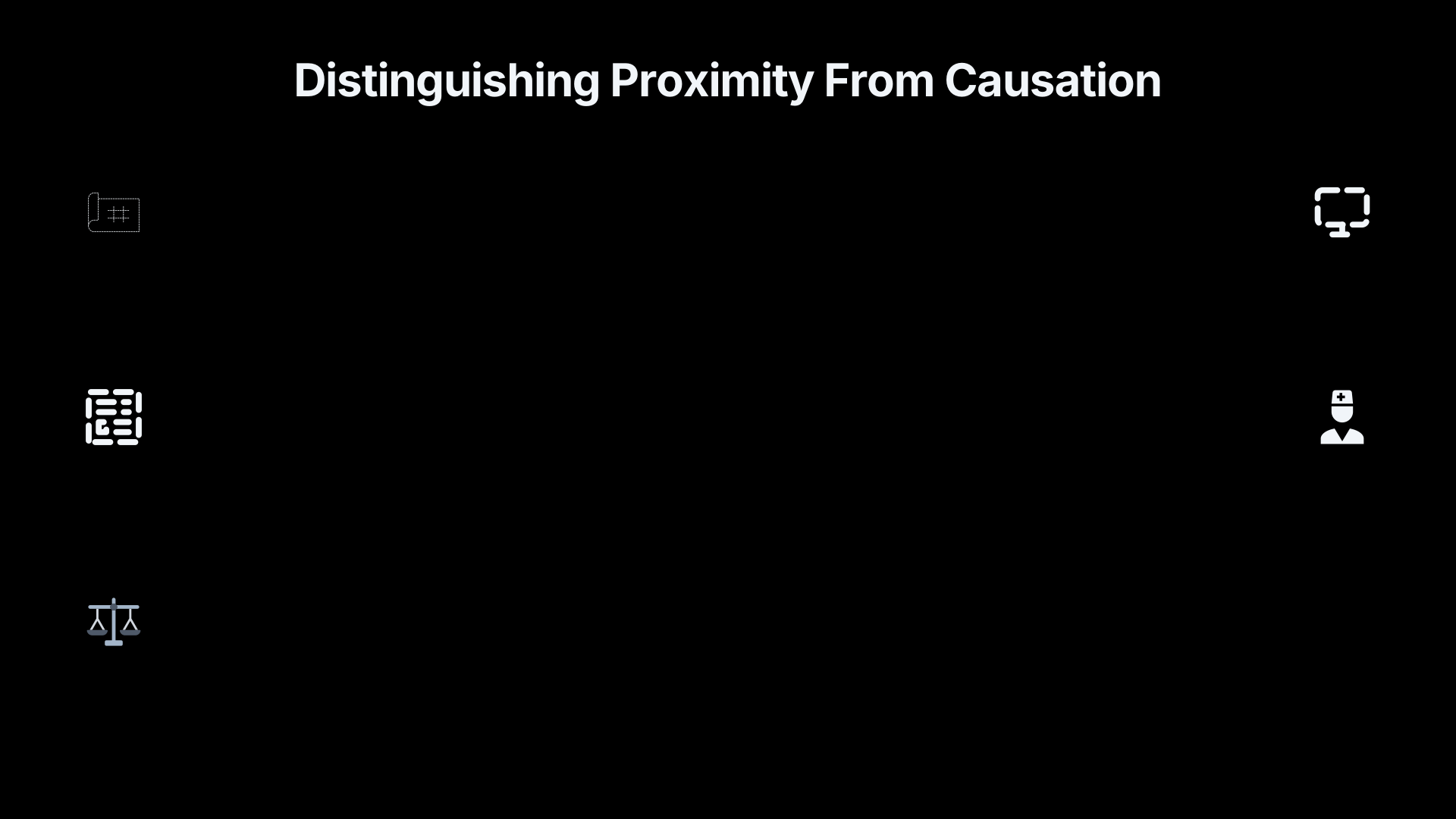
Several tests help distinguish proximity from causation.
Was the person actually involved in the alleged subject matter? Working at a laboratory does not automatically mean involvement in UFO, propulsion or classified aerospace programmes.
Is there evidence of a specific threat? A credible theory requires more than institutional affiliation. It needs indications that someone had a motive, capability and opportunity.
Do the cases share verifiable links? Similar employers are not enough. Stronger indicators would include common actors, communications, operational patterns or documented connections.
Are alternative explanations being examined equally? Financial problems, health issues, accidents, interpersonal conflicts and ordinary crime often receive less attention than dramatic theories, despite frequently being more strongly supported by evidence.
Would the same reasoning be persuasive without the laboratory connection? If the answer is no, the argument may depend more on institutional mystique than on facts.
The Proximity Trap in Context
The enduring lesson is that classified laboratories can function as suspicion multipliers. Their secrecy is real, their work is important, and their histories often intersect with subjects that already attract public fascination. Yet those same characteristics make them fertile ground for narratives that transform association into evidence.
In UFO and alleged antigravity death stories, proximity often serves as the bridge between an unexplained tragedy and a theory of deliberate silencing. Understanding that mechanism does not prove that every event is innocent or every conspiracy claim is false. It simply highlights a recurring analytical error: treating a person’s location near secrets as proof that the secrets caused what happened to them. The distinction between those two ideas is where careful investigation begins.[apnews.com]apnews.comAP NewsHow conspiracy theories about missing or dead scientists…April 24, 2026 — 24 Apr 2026 — But so far no evidence has been found t…
Amazon book picks
Further Reading
Books and field guides related to How Proximity Turns Tragedy Into Theory. Use these as the next step if you want deeper reading beyond the article.
Suspicious Minds
Explains the mental processes that turn coincidences, secrecy and institutional links into conspiracy narratives.
Mistakes Were Made (but Not by Me)
Helps readers understand cognitive biases and self-reinforcing belief systems that sustain unsupported theories.
The Demon-Haunted World
Rating: 4.5/5 from 43 Google Books ratings
Directly addresses how people infer hidden causes and conspiracies from limited evidence.
Calling Bullshit
Provides tools for separating evidence-based conclusions from persuasive but weak inference chains.
eBay marketplace picks
Marketplace Samples
Live-tested eBay searches with available results related to this page.


Endnotes
1.
Source: Wikipedia
Title: Missing scientists conspiracy theory
Link:https://en.wikipedia.org/wiki/Missing_scientists_conspiracy_theory
2.
Source: pmc.ncbi.nlm.nih.gov
Link:https://pmc.ncbi.nlm.nih.gov/articles/PMC5900972/
Source snippet
Connecting the dots: Illusory pattern perception predicts belief...by JW van Prooijen · 2017 · Cited by 459 — We conclude that illuso...
3.
Source: pmc.ncbi.nlm.nih.gov
Title: PMCThe Psychology of Conspiracy Theories
Link:https://pmc.ncbi.nlm.nih.gov/articles/PMC5724570/
Source snippet
We conclude that conspiracy belief appears to stem...Read more...
4.
Source: pmc.ncbi.nlm.nih.gov
Link:https://pmc.ncbi.nlm.nih.gov/articles/PMC6238178/
Source snippet
Theories: Evolved Functions and Psychological...by JW van Prooijen · 2018 · Cited by 630 — One key element of any conspiracy theory is p...
5.
Source: bpspsychub.onlinelibrary.wiley.com
Title: Illusory pattern
Link:https://bpspsychub.onlinelibrary.wiley.com/doi/full/10.1111/bjop.70016
Source snippet
existential threats increase conspiracy beliefs: Evidence...by JY Mao · Cited by 2 — Existential threats were positively correlated with...
6.
Source: Wikipedia
Title: COVID 19 lab leak theory
Link:https://en.wikipedia.org/wiki/COVID-19_lab_leak_theory
Source snippet
COVID-19 lab leak theoryA highly controversial hypothesis holds that SARS-CoV-2, the virus responsible for the COVID-19 pandemic, orig...
7.
Source: apnews.com
Link:https://apnews.com/article/scientists-missing-dead-conspiracy-theories-c046ce6d0a004e6a3e1971ff769244b5
Source snippet
AP NewsHow conspiracy theories about missing or dead scientists...April 24, 2026 — 24 Apr 2026 — But so far no evidence has been found t...
Published: April 24, 2026
8.
Source: cbsnews.com
Title: deaths disappearances scientists staff government labs
Link:https://www.cbsnews.com/news/deaths-disappearances-scientists-staff-government-labs/
Source snippet
FBI investigating deaths and disappearances of staff at...21 Apr 2026 — The disappearances and deaths of 10 government workers tied to n...
9.
Source: research.vu.nl
Title: connecting the dots illusory pattern perception predicts belief i
Link:https://research.vu.nl/en/publications/connecting-the-dots-illusory-pattern-perception-predicts-belief-i/
Source snippet
Vrije Universiteit AmsterdamIllusory pattern perception predicts belief in conspiracies...by JW van Prooijen · 2018 · Cited by 473 — A c...
10.
Source: verywellmind.com
Link:https://www.verywellmind.com/baader-meinhof-phenomenon-11902674
Source snippet
This effect is attributed to two psychological mechanisms: selective attention, which filters focus onto new stimuli, and confirmation bi...
11.
Source: pmc.ncbi.nlm.nih.gov
Link:https://pmc.ncbi.nlm.nih.gov/articles/PMC6282862/
Source snippet
by RC van der Wal · 2018 · Cited by 128 — Four studies indicate that conspiracy belief is driven by readiness to draw implausible caus...
12.
Source: pmc.ncbi.nlm.nih.gov
Link:https://pmc.ncbi.nlm.nih.gov/articles/PMC6282974/
Source snippet
in conspiracy theories: Basic principles of an emerging...by JW van Prooijen · 2018 · Cited by 759 — The first process is pattern percep...
13.
Source: pmc.ncbi.nlm.nih.gov
Link:https://pmc.ncbi.nlm.nih.gov/articles/PMC9893368/
Source snippet
by M Hartmann · 2023 · Cited by 16 — These results further suggest that illusory pattern perception is a common mechanism behind consp...
Additional References
14.
Source: bps.org.uk
Link:https://www.bps.org.uk/research-digest/believers-conspiracy-theories-and-paranormal-are-more-likely-see-illusory-patterns
Source snippet
Believers in conspiracy theories and the paranormal are...17 Oct 2017 — "We conclude that illusory pattern perception is a central cogni...
15.
Source: facebook.com
Title: at least 10 workers at secretive government labs have died or disappeared since
Link:https://www.facebook.com/CBSNews/posts/at-least-10-workers-at-secretive-government-labs-have-died-or-disappeared-since-/1365262345465606/
Source snippet
At least 10 workers at secretive government labs have died...Based on recent data, approximately 9000 to 10000+ people die in New Mexico...
16.
Source: youtube.com
Link:https://www.youtube.com/watch?v=YI5BpLl8TZk
Source snippet
What's Really Going On With The Missing Scientists...[https://fabletics.com/...!](https://fabletics.com/...!) · #FableticsPartner Many of you may have heard of the co...
17.
Source: youtube.com
Link:https://www.youtube.com/watch?v=HDHK51O__Y0
18.
Source: research.vu.nl
Link:https://research.vu.nl/en/publications/why-existential-threats-increase-conspiracy-beliefs-evidence-for-/
Source snippet
Existential Threats Increase Conspiracy Beliefsby J Mao · 2025 · Cited by 3 — This research investigates the cognitive mechanisms linking...
19.
Source: psychologicalscience.org
Title: Coincidence or Conspiracy?
Link:https://www.psychologicalscience.org/news/releases/coincidence-or-conspiracy-studies-investigate-conspiracist-thinking.html
Source snippet
Studies Investigate...Oct 1, 2015 — To investigate the relationship between conspiracist beliefs and perceptions of randomness, the rese...
20.
Source: tandfonline.com
Title: European Journal of Social Psychology, 48(3), 320–335
Link:https://www.tandfonline.com/doi/full/10.1080/20445911.2023.2198064
Source snippet
Full article: Conspiracy theories: why they are believed and...by I Sebalo · 2023 · Cited by 6 — Connecting the dots: Illusory pattern p...
21.
Source: reddit.com
Link:https://www.reddit.com/r/psychology/comments/n5lk2p/a_review_of_the_literature_on_the_psychology_of/
Source snippet
hat belief in conspiracies is driven by their “promise to satisfy...
22.
Source: facebook.com
Link:https://www.facebook.com/cnn/posts/a-federal-investigation-is-underway-after-at-least-10-people-connected-to-sensit/1340711991254782/
Source snippet
sensitive US research have died or disappeared in recent years...
23.
Source: reddit.com
Link:https://www.reddit.com/r/interesting/comments/1svd710/11_scientists_who_mysteriously_disappeared_and/
Source snippet
He was a construction foreman. He was 78 and is missing. This...
Topic Tree