Within UFO Death Claims
What the Antigravity Document Really Means
The DIA antigravity document shows exotic ideas were considered, not that working craft or lethal secrets existed.
On this page
- Why the document matters
- What it does not prove
- How speculative research becomes lore
Page outline Jump by section
Introduction
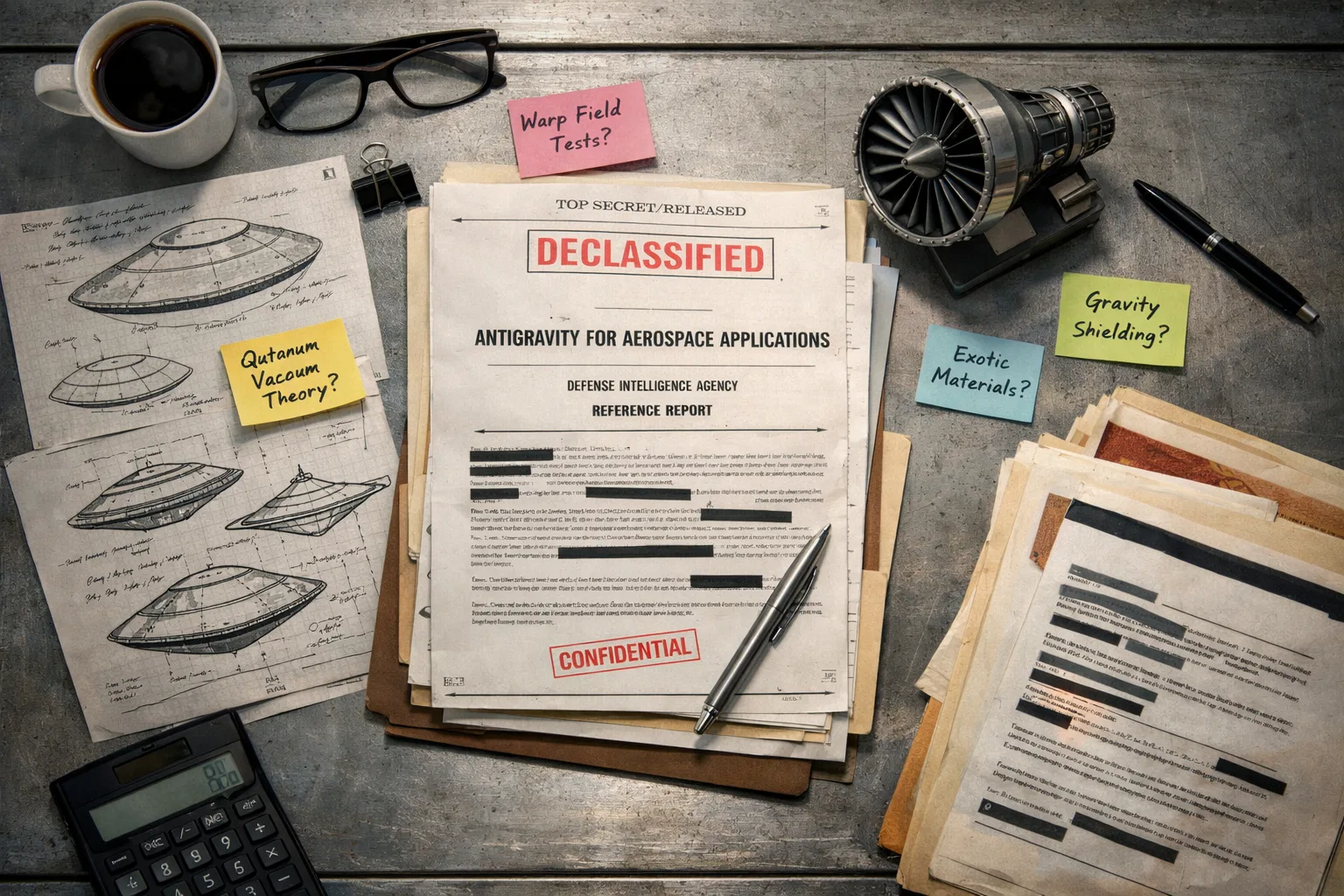
The Defense Intelligence Agency’s “Antigravity for Aerospace Applications” document is real, but its meaning is often overstated. It shows that a U.S. defence-funded programme paid for a theoretical review of possible gravity-control concepts, including ideas from general relativity, quantum vacuum physics and speculative propulsion research. It does not show that the U.S. government possessed antigravity craft, that UFO propulsion had been solved, or that scientists held secrets dangerous enough to explain suspicious deaths or disappearances. The document matters because it sits exactly where folklore grows: official letterhead, exotic physics, redactions, UFO-adjacent funding and phrases such as “antigravity” in a government archive. The sober reading is narrower and more interesting: defence analysts wanted to survey remote, potentially disruptive aerospace ideas, and the resulting paper repeatedly acknowledged that many concepts were far from practical engineering.[Defense Intelligence Agency]dia.milDefense Intelligence Agency Antigravity for Aerospace ApplicationsDefense Intelligence Agency Antigravity for Aerospace Applications
Why the Document Matters
“Antigravity for Aerospace Applications” was one of the Defense Intelligence Reference Documents produced under the Advanced Aerospace Weapon System Application Program, or AAWSAP, a DIA-managed contract connected to the better-known AATIP controversy. A 2009 Department of Defense memorandum says the programme’s purpose was to investigate “revolutionary advances in future aerospace technologies”, especially unconventional technologies, and that Bigelow Aerospace Advanced Space Studies was the sole bidder for the contract. The same memo says the work involved unclassified research and technical reports, not an already operational secret weapons programme.[Defense Intelligence Agency]dia.milDefense Intelligence Agency
That distinction is central. The antigravity paper was not a leaked engineering manual. It was a reference study: a literature review and speculative assessment of possible routes by which gravity might, in principle, be modified or counteracted. Its foreword says it reviews theoretical approaches to “manipulating spacetime” and asks which methods might be best suited to aerospace applications, while also evaluating the limiting issues.[Defense Intelligence Agency]dia.milDefense Intelligence Agency Antigravity for Aerospace ApplicationsDefense Intelligence Agency Antigravity for Aerospace Applications
The paper is still important because it reveals what kinds of ideas were considered worth surveying inside a defence-warning context. A DIA briefing list of technical report review results places “Antigravity for Aerospace Applications” alongside subjects such as wormholes, gravity-wave communication, superconductors in gravity research, invisibility cloaking, positron propulsion, vacuum energy applications and warp drives. That list is a useful corrective to both extremes: the work was not imaginary, but its inclusion among many highly speculative topics should caution against treating it as proof of a breakthrough.[Defense Intelligence Agency]dia.milDefense Intelligence Agency
The most revealing lines are inside the document itself. After discussing the attraction of active gravity control for flight, it states plainly: “To date, there is no technology that can achieve the active control of gravity.” It then explains why such a capability would be transformative if it existed: aircraft and rockets could reduce the propellant and structure normally required to overcome Earth’s gravity. The paper therefore frames antigravity as a possible future aerospace prize, not as a capability already in hand.[Defense Intelligence Agency]dia.milDefense Intelligence Agency Antigravity for Aerospace ApplicationsDefense Intelligence Agency Antigravity for Aerospace Applications
What the Document Actually Says
The DIA document uses “antigravity” in a broad technical sense: negating, counteracting or repelling gravity, with “gravity control” used as the wider term. It moves through several classes of ideas, ranging from Newtonian thought experiments to general relativity and quantum-field effects. Some examples are deliberately impractical. The Newtonian section discusses cancelling Earth’s gravity with another planet-sized mass or with ultradense compact matter, then immediately notes that these are not feasible engineering solutions because humans cannot create or handle such matter.[Defense Intelligence Agency]dia.milDefense Intelligence Agency Antigravity for Aerospace ApplicationsDefense Intelligence Agency Antigravity for Aerospace Applications
That pattern repeats through the paper. The author is willing to examine extreme possibilities, but the document regularly separates mathematical possibility from usable technology. In the introduction, it warns that many of the concepts are “nowhere near” any practicable engineering implementation. Later, when discussing negative energy, it notes that tiny quantities have been produced in laboratory contexts, but that the astronomical amounts needed for significant antigravity forces remain far beyond current technology.[Defense Intelligence Agency]dia.milDefense Intelligence Agency Antigravity for Aerospace ApplicationsDefense Intelligence Agency Antigravity for Aerospace Applications
One of the more easily misread passages concerns quantum vacuum and interatomic dispersion-force ideas. The paper discusses theoretical work in which carefully prepared atoms, external fields and laser manipulation might produce a “self-lifting” force. The page looks dramatic because it includes estimates that, under certain assumptions, a cluster of trapped atoms could hover or generate upward thrust. But the text is not describing a flying vehicle or a hidden propulsion device; it is discussing a chain of theoretical magnifications, laboratory-scale conditions, trapped particles and unresolved technical challenges.[Defense Intelligence Agency]dia.milDefense Intelligence Agency Antigravity for Aerospace ApplicationsDefense Intelligence Agency Antigravity for Aerospace Applications
This is how a speculative defence reference paper should be read: not as a binary declaration that “antigravity is real” or “antigravity is fake”, but as a survey of conjectural mechanisms, energy barriers and possible research paths. The document’s evidential value is strongest for one claim only: that exotic gravity-control concepts were considered inside an official aerospace-threat research setting.
What It Does Not Prove
The most common misreading is to treat the DIA logo as proof of validation. Government interest does not equal scientific confirmation. Defence agencies routinely monitor uncertain, emerging or adversarial technologies before they are mature, partly because the cost of missing a genuine breakthrough could be high. A technology-warning office can commission speculative analysis without believing that the technology works.
The public record around AAWSAP reinforces that point. A 2009 memorandum reviewing Senator Harry Reid’s request to place the programme under Special Access Program protection recommended against doing so. It said DIA saw no justification for Special Access protections based on the programme’s deliverables or anticipated work, and described the fiscal-year deliverables as academic and basic scientific research. It also stated that the current level of scientific capability did not appear to risk grave damage to national security if the available information were revealed.[Defense Intelligence Agency]dia.milDefense Intelligence Agency
That is one of the strongest pieces of evidence against the “lethal secret” interpretation. If the antigravity study had represented a working propulsion breakthrough, or a body of secrets whose disclosure could expose revolutionary craft, the internal security review would be difficult to square with a recommendation against extraordinary protection. The memo does not disprove every classified aerospace activity, but it does weaken the claim that these particular reference documents were treated as explosive proof of hidden antigravity vehicles.[Defense Intelligence Agency]dia.milDefense Intelligence Agency
The document also does not prove that UAP are powered by gravity-control systems. AARO’s 2024 historical review says it examined U.S. government UAP investigations, classified and unclassified archives, interviews and oversight channels. Its executive summary found no evidence that any U.S. government investigation, academic-sponsored research or official review panel had confirmed that a UAP sighting represented extraterrestrial technology, and it found no empirical evidence that the U.S. government or private companies had been reverse-engineering extraterrestrial technology.[U.S. Department of War]media.defense.govU.S. Department of War AARO Historical Record Report Volume 1U.S. Department of War AARO Historical Record Report Volume 1(https://media.defense.gov/2024/Mar/08/2003409233/-1/-1/0/DOPSR-2024-0263-AARO-HISTORICAL-RECORD-REPORT-VOLUME-1-2024.PDF)
Nor does the paper prove that researchers connected to antigravity or UFO topics were being silenced. Recent reporting on missing or deceased scientists shows how quickly unrelated tragedies can be woven into an online pattern, but the documented basis for coordinated foul play remains weak. AP reported that speculation about dead or missing scientists moved from niche online spaces into national politics, but the public evidence did not establish a definitive connection among the cases or prove a coordinated plot.[AP News]apnews.comAP News How conspiracy theories about missing or dead scientistsAP News How conspiracy theories about missing or dead scientists

How Speculative Research Becomes Lore
The antigravity document became lore because it contains several ingredients that online UFO culture is especially good at amplifying. First, it is official: it came from a DIA programme. Second, it is exotic: it discusses spacetime manipulation, quantum vacuum effects, negative energy and gravity control. Third, it emerged through Freedom of Information Act releases and document archives, which give the material the feel of recovered secrecy. Fourth, it appeared in the orbit of AAWSAP/AATIP, a programme already associated in the public mind with UFO investigations.
Journalists who covered the AAWSAP document releases noted this ambiguity early. The War Zone described the reports as real Pentagon-linked studies into warp drive, extra dimensions and antigravity, while also stressing that neither report showed such technologies were close to practicality or that any foreign government was near such a breakthrough. Vice similarly reported that the documents revealed exotic and sometimes strange research priorities, but said none of the technologies appeared to have come remotely close to reality based on the public record.[TWZ]twz.comOpen source on twz.com.
The lore grows when readers collapse four different categories into one:
- A theoretical possibility becomes “physics says it can be done”.
- A defence-funded review becomes “the Pentagon has the technology”.
- A redacted or formerly restricted document becomes “this was too dangerous to reveal”.
- A real researcher’s tragedy or disappearance becomes “they knew the secret”.
Each step feels intuitive if someone already expects a cover-up, but each step adds an inference not supplied by the evidence. The DIA document supports the first two words of the claim — “official interest” — far better than it supports the dramatic conclusion.
The Superconductor Thread and the Replication Problem
Part of the document’s cultural force comes from older antigravity stories involving superconductors, especially the claims associated with Ning Li and Eugene Podkletnov. These names often appear in gravity-control discussions because they sit at the boundary between real physics, fringe claims and failed replication. Discover magazine summarised the 1990s arc: Li published theoretical work, Podkletnov reported a gravity-reduction effect involving a spinning superconductor, NASA showed interest in testing the idea, and the subject later faded after claims were withdrawn, disputed or not convincingly reproduced.[Discover Magazine]discovermagazine.comDiscover Magazine Whatever Happened to Antigravity Research?Discover Magazine Whatever Happened to Antigravity Research?
That history matters because it shows how a technical anomaly can become a durable myth even after the scientific basis weakens. A claim of small weight reduction under unusual laboratory conditions is not the same as a controllable aerospace drive. Even if a surprising laboratory effect were real, it would still have to pass replication, scaling, energy accounting, materials engineering, safety testing and integration into an aircraft or spacecraft. The DIA document’s own language repeatedly points to that gulf between idea and implementation.[Defense Intelligence Agency]dia.milDefense Intelligence Agency Antigravity for Aerospace ApplicationsDefense Intelligence Agency Antigravity for Aerospace Applications
The superconductors thread also illustrates why “suppressed breakthrough” is not the only explanation for a missing technology. A more ordinary explanation is that the original effects were measurement artefacts, misunderstood physical interactions, incomplete experiments or claims that did not survive independent testing. In speculative propulsion, non-replication is not a minor detail; it is usually the difference between a research curiosity and a technology.

The Best Reading of the “Misread Secrets”
The best reading of the DIA antigravity document is neither dismissive nor sensational. It is evidence that the U.S. defence establishment, through AAWSAP, paid for a wide survey of far-future aerospace concepts, including some that sit near the edge of accepted physics and some that were far beyond engineering reach. It is also evidence that the programme’s technical outputs were internally reviewed as academic or basic research rather than as secrets requiring the highest protective compartment.[Defense Intelligence Agency]dia.milDefense Intelligence Agency
The misread secret is the assumption that official curiosity equals operational capability. The document is valuable precisely because it shows the opposite: an intelligence-linked programme trying to map what might matter someday, not revealing what already worked. In the broader branch of UFO and antigravity-related suspicious-death claims, this makes the document a weak foundation for sinister conclusions. It can help explain why people connect UFOs, defence research and gravity control in their imaginations; it does not establish that researchers were killed or disappeared for knowing too much.
A careful reader should therefore treat the document as a data point about institutional interest, not as a smoking gun. It belongs in the history of how government, aerospace speculation and UFO culture became entangled. It does not, on the available public evidence, turn antigravity research into proof of hidden craft, extraterrestrial reverse-engineering or lethal secrecy.
Amazon book picks
Further Reading
Books and field guides related to What the Antigravity Document Really Means. Use these as the next step if you want deeper reading beyond the article.
The Hunt for Zero Point
Directly addresses antigravity stories, military research claims, and the gap between rumor and evidence.
Physics of the Impossible
Examines ideas such as advanced propulsion and other concepts often associated with antigravity discussions.
American Cosmic
Explores how belief, institutions, and technology narratives transform ambiguous evidence into modern folklore.
The Demon-Haunted World
Rating: 4.5/5 from 43 Google Books ratings
Offers tools for evaluating extraordinary claims and separating evidence from speculation.
eBay marketplace picks
Marketplace Samples
Live-tested eBay searches with available results related to this page.




Endnotes
1.
Source: dia.mil
Title: Defense Intelligence Agency Antigravity for Aerospace Applications
Link:https://www.dia.mil/FOIA/FOIA-Electronic-Reading-Room/FileId/237651/
2.
Source: dia.mil
Title: Defense Intelligence Agency
Link:https://www.dia.mil/FOIA/FOIA-Electronic-Reading-Room/FileId/237660/
3.
Source: dia.mil
Title: Defense Intelligence Agency
Link:https://www.dia.mil/FOIA/FOIA-Electronic-Reading-Room/FileId/170018/
4.
Source: media.defense.gov
Title: U.S. Department of War AARO Historical Record Report Volume 1
Link:https://media.defense.gov/2024/Mar/08/2003409233/-1/-1/0/DOPSR-2024-0263-AARO-HISTORICAL-RECORD-REPORT-VOLUME-1-2024.PDF
5.
Source: twz.com
Link:https://www.twz.com/20797/the-pentagon-paid-for-these-reports-on-warp-drive-extra-dimensions-anti-gravity-and-more
6.
Source: vice.com
Link:https://www.vice.com/en/article/newly-released-documents-shed-light-on-government-funded-research-into-worm-holes-anti-gravity-and-invisibility-cloaks/
7.
Source: science.nasa.gov
Title: uap independent study team final report
Link:https://science.nasa.gov/wp-content/uploads/2023/09/uap-independent-study-team-final-report.pdf
8.
Source: science.nasa.gov
Link:https://science.nasa.gov/uap/
9.
Source: dia.mil
Title: File Id
Link:https://www.dia.mil/FOIA/FOIA-Electronic-Reading-Room/FileId/170027/
10.
Source: dia.mil
Title: File Id
Link:https://www.dia.mil/FOIA/FOIA-Electronic-Reading-Room/FileId/170060/
11.
Source: dia.mil
Title: File Id
Link:https://www.dia.mil/FOIA/FOIA-Electronic-Reading-Room/FileId/170015/
12.
Source: dia.mil
Title: FOIA Request Log 2022
Link:https://www.dia.mil/Portals/110/Documents/FOIA/All%20PDFs/FOIA_Request_Log_2022.pdf
13.
Source: dia.mil
Title: File Id
Link:https://www.dia.mil/FOIA/FOIA-Electronic-Reading-Room/FileId/170046/
14.
Source: aaro.mil
Title: UAP Records
Link:https://www.aaro.mil/UAP-Records/
15.
Source: aaro.mil
Link:https://www.aaro.mil/UAP-Cases/Official-UAP-Imagery/
16.
Source: aaro.mil
Link:https://www.aaro.mil/
17.
Source: apnews.com
Title: AP News How conspiracy theories about missing or dead scientists
Link:https://apnews.com/article/scientists-missing-dead-conspiracy-theories-c046ce6d0a004e6a3e1971ff769244b5
18.
Source: discovermagazine.com
Title: Discover Magazine Whatever Happened to Antigravity Research?
Link:https://www.discovermagazine.com/whatever-happened-to-antigravity-research-15567
19.
Source: Wikipedia
Title: Defense Intelligence Agency
Link:https://en.wikipedia.org/wiki/Defense_Intelligence_Agency
20.
Source: Wikipedia
Title: Eugene Podkletnov
Link:https://en.wikipedia.org/wiki/Eugene_Podkletnov
21.
Source: diabrowser.com
Link:https://www.diabrowser.com/
Additional References
22.
Source: youtube.com
Link:http://www.youtube.com/watch?v=mvsU4p0Gsas
Source snippet
DIA AAWSAP Defense Intelligence Reference Documents UAP antigravity AATIP, AAWSAP, and the 38 DIRDs: The Pentagon's $22M UAP Program 4orbs...
23.
Source: youtube.com
Title: Secret Pentagon Program (Full Episode) | UFOs: Investigating the Unknown
Link:http://www.youtube.com/watch?v=Wt7Riw9jGlQ
Source snippet
Breaking Down UAP Footage with the Head of The Pentagon’s UAP Taskforce, Dr. Jon Kosloski...
24.
Source: youtube.com
Title: Harry Reid: The Senator Who Bought the Pentagon’s UAP Program
Link:http://www.youtube.com/watch?v=jY3113xJ5J4
Source snippet
Secret Pentagon Program (Full Episode) | UFOs: Investigating the Unknown...
25.
Source: youtube.com
Title: AATIP, AAWSAP, and the 38 DIRDs: The Pentagon’s $22M UAP Program
Link:http://www.youtube.com/watch?v=Fd2U0-Q8jDk
Source snippet
Jim Lacatski: The DIA Officer Who Ran the Pentagon's UAP Program...
26.
Source: youtube.com
Title: Jim Lacatski: The DIA Officer Who Ran the Pentagon’s UAP Program
Link:http://www.youtube.com/watch?v=1NR12Dmn2w0
Source snippet
Harry Reid: The Senator Who Bought the Pentagon's UAP Program...
27.
Source: facebook.com
Link:https://www.facebook.com/Discovery/posts/aatip-stands-for-advanced-aerospace-threat-identification-program-and-its-very-r/10157346249393586/
28.
Source: academia.edu
Link:https://www.academia.edu/44615051/The_Pentagons_UAP_Task_Force
29.
Source: researchgate.net
Link:https://www.researchgate.net/publication/402834861Unified_Classical_Resonance_Model_UCRM_Resonant_Plasmoids_Bio-ELFPsionics_Sixth_Oscillator_Remote_ViewingESP_Anomalous_Cognition_Gravity_Control_and_Zero-Point_Energy_Rectification-_The_MC-BE-CIRE_Hy
30.
Source: hiroko.or.jp
Link:https://hiroko.or.jp/wp-content/file/gravity-control/Gravitational%20shielding/ShieldingBySuperconductivity/General%20remarks/803-page-Collection-of-Papers-on-Anti-Gravity-Research.pdf
31.
Source: solveforce.com
Link:https://solveforce.com/aawsap/
Topic Tree
Follow this branch
Parent topic
UFO Death ClaimsRelated pages 29
- AARO Review What AARO Said About Hidden UFO Technology
- AAWSAP What Paid for the Antigravity Report?
- DIA Interest Did DIA Interest Mean Antigravity Was Real?
- Negative Energy Why Negative Energy Sounds More Useful Than It Is
- SAP Rejection Would a Breakthrough Have Been Left Unprotected?
- +1 more in sidebar