Within Sensitive Labs
Why Nuclear Lab Secrecy Is Built In
Nuclear secrecy has a specific legal structure that can look suspicious when readers do not know how Restricted Data works.
On this page
- What Restricted Data means in plain language
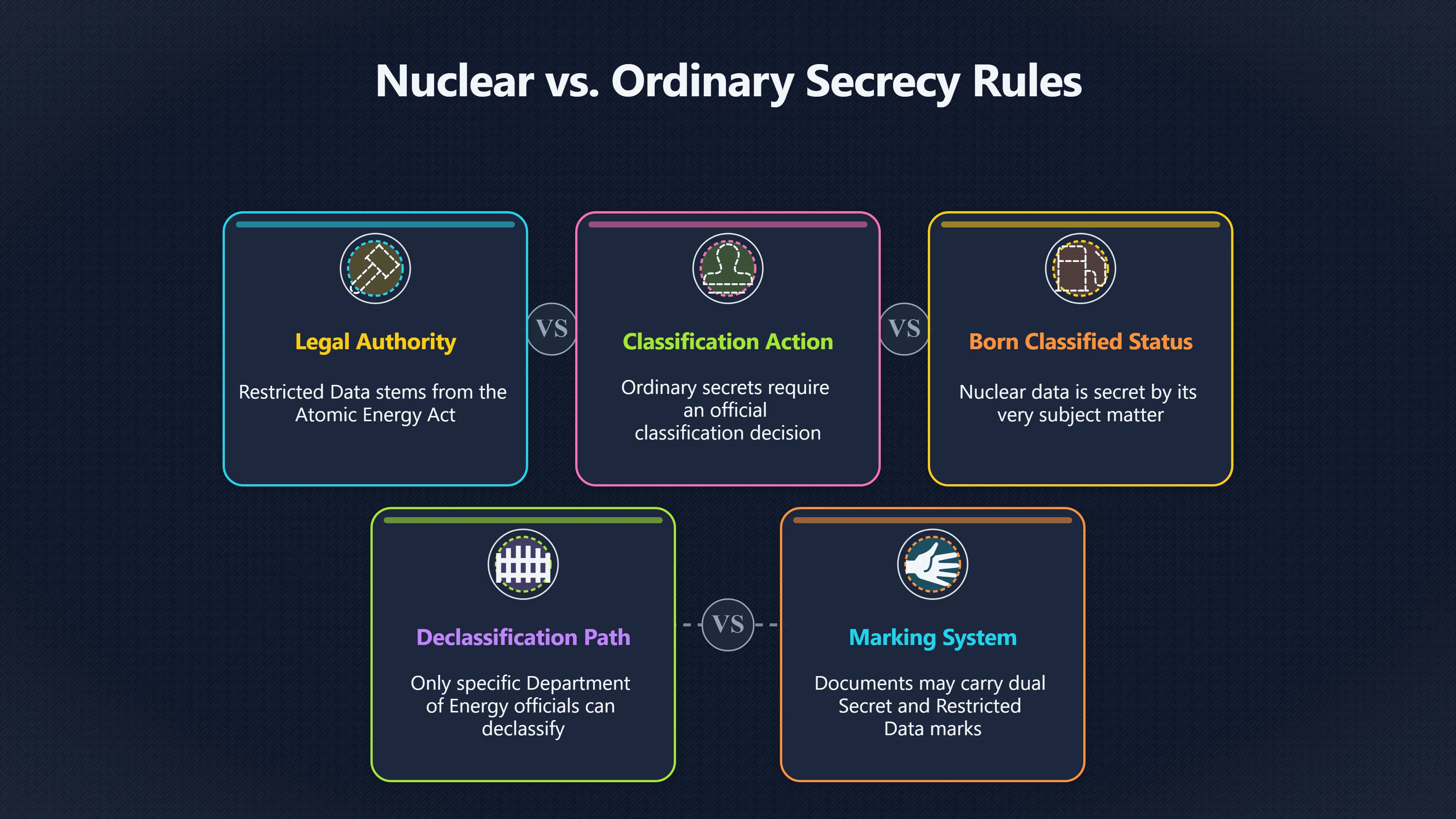
- How nuclear classification differs from ordinary secrets
- Why lawful secrecy can still fuel extraordinary claims
Page outline Jump by section
Introduction
In discussions about UFO research, alleged antigravity projects and the deaths or disappearances of scientists, secrecy surrounding major national-security laboratories is often treated as evidence that extraordinary programmes must be hidden behind closed doors. A key fact is frequently overlooked: some of that secrecy is not discretionary at all. In the United States, nuclear-weapons information is governed by a specialised legal regime created by the Atomic Energy Act, which operates differently from ordinary government classification systems. Information connected to nuclear weapons can fall into the category known as Restricted Data, a status that is legally distinct from standard national-security secrets and is protected under rules that were designed specifically to prevent the spread of nuclear-weapons knowledge.[doe.gov]directives.doe.govrestricted dataDataRestricted Data. Definition. As defined in the Atomic Energy Act of 1954, all information concerning -. the design, manufacture, or u…
 Understanding these rules matters because they help explain why records from nuclear laboratories can remain inaccessible, heavily redacted or difficult to discuss publicly even when there is no evidence of hidden UFO or antigravity programmes. The legal architecture itself can create an appearance of mystery that outsiders may interpret as proof of something more extraordinary than the available evidence supports.
What Restricted Data Means in Plain Language
The Atomic Energy Act created a category called Restricted Data (RD) covering information about nuclear weapons design, manufacture and use, the production of special nuclear materials such as plutonium and highly enriched uranium, and certain aspects of nuclear energy production. Unlike most classified information, Restricted Data is defined directly in statute rather than solely through executive orders.[doe.gov]directives.doe.govrestricted dataDataRestricted Data. Definition. As defined in the Atomic Energy Act of 1954, all information concerning -. the design, manufacture, or u…
The unusual feature is that nuclear information is commonly described as being “born classified” or “born secret.” In practical terms, this means that if information falls within the statutory definition of Restricted Data, it is treated as classified by law even if no official has formally stamped it Secret or Top Secret. The legal protection flows from the subject matter itself rather than from a separate act of classification.[fas.org]sgp.fas.orgProject on Government Secrecy Chapter 3CLASSIFICATION OF INFORMATIONThe authority for classifying information as RD or FRD comes from the Atomic Energy Act of 1954. The current…
This principle developed from post-war concerns that nuclear-weapons knowledge was uniquely dangerous and could not be protected adequately through ordinary secrecy mechanisms. As a result, the law assumes that certain categories of nuclear information require protection unless and until the government deliberately removes them from that status.[Wikipedia]WikipediaRestricted DataNovember 3, 2025 — Restricted Data (RD) is a category of classified information in the United States that is defined by the Atomic Energy…
For researchers, archivists and historians, this creates a very different environment from most government records. Documents may remain restricted not because they reveal a current covert operation but because they contain information that still falls within a legally protected nuclear category. Legal Information Institute+2The Department of Energy’s Energy.gov[law.cornell.edu]law.cornell.eduLegal Information InstituteWho is responsible for declassifying Restricted Data, Formerly…Only designated officials within the Departm…
How Nuclear Classification Differs from Ordinary Secrets
Most classified government information in the United States falls under the category of National Security Information (NSI). Under that system, an authorised official makes a conscious decision that disclosure could damage national security and formally classifies the information. Executive orders establish the rules for classification, handling and declassification.[The Department of Energy's Energy.gov]energy.govstatutes regulations and directives classification programThe Department of Energy's Energy.govStatutes, Regulations, and Directives for Classification…Atomic Energy Act of 1954 - Establishes…
[Nuclear information operates differently.]sgp.fas.orgFAS Project on Government SecrecyProtecting the Nation's Nuclear InformationF ormerly Restricted Data is defined by the Atomic Energy Act…
Several distinctions are especially important:
- Different legal authority: Restricted Data derives from the Atomic Energy Act, while ordinary national-security information derives primarily from executive orders.[The Department of Energy's Energy.gov]energy.govstatutes regulations and directives classification programThe Department of Energy's Energy.govStatutes, Regulations, and Directives for Classification…Atomic Energy Act of 1954 - Establishes…
- Born-classified status: Restricted Data can exist without any original classification decision, whereas ordinary national-security information requires an affirmative classification action.[FAS Project on Government Secrecy]sgp.fas.orgProject on Government Secrecy Chapter 3CLASSIFICATION OF INFORMATIONThe authority for classifying information as RD or FRD comes from the Atomic Energy Act of 1954. The current…
- Different declassification process: Only designated Department of Energy officials can declassify Restricted Data, and some categories require coordination with other agencies.[Legal Information Institute]law.cornell.eduLegal Information InstituteWho is responsible for declassifying Restricted Data, Formerly…Only designated officials within the Departm…
- Separate marking system: A document may be marked Secret or Top Secret while simultaneously carrying Restricted Data designations. The RD designation describes the nature of the information, not simply its sensitivity level.[Wikipedia]WikipediaRestricted DataNovember 3, 2025 — Restricted Data (RD) is a category of classified information in the United States that is defined by the Atomic Energy…
The system also includes Formerly Restricted Data (FRD), a category created when information is removed from Restricted Data because it primarily concerns the military use of nuclear weapons and can be protected under broader national-security classification rules. Even after this transfer, the information remains classified. FAS Project on Government Secrecy+2Energy.gov[sgp.fas.org]sgp.fas.orgFAS Project on Government SecrecyProtecting the Nation's Nuclear InformationF ormerly Restricted Data is defined by the Atomic Energy Act…
This layered structure is one reason outsiders often find nuclear secrecy unusually difficult to navigate. Records may be withheld under authorities that are unfamiliar even to people who understand conventional government classification.
Why Nuclear Laboratories Often Appear More Secretive Than Other Facilities
National-security laboratories associated with nuclear weapons programmes operate inside this specialised legal framework. Facilities such as Los Alamos, Lawrence Livermore and Sandia are not simply managing ordinary classified projects; they routinely handle information governed by the Atomic Energy Act. As a result, records can be reviewed, redacted and retained under procedures that differ from those used elsewhere in government.[The Department of Energy's Energy.gov]energy.govstatutes regulations and directives classification programThe Department of Energy's Energy.govStatutes, Regulations, and Directives for Classification…Atomic Energy Act of 1954 - Establishes…
The practical effects can be striking. Historical records that appear decades old may still undergo nuclear-classification review. Agencies have repeatedly conducted reviews to prevent the accidental public release of Restricted Data or Formerly Restricted Data. In some cases, records that had been prepared for public release were later found to contain protected nuclear information and were withdrawn or corrected.[FAS Project on Government Secrecy]sgp.fas.orgFAS Project on Government SecrecyReport on Inadvertent Releases of Restricted Data…In fact, Department of Energy staff has prevented t…
To members of the public, these actions can resemble efforts to conceal broader secrets. Yet in many cases the immediate issue is compliance with nuclear-classification law rather than protection of an unrelated hidden programme. The distinction is important because secrecy can arise from routine legal obligations rather than from evidence of extraordinary activities.
Why Lawful Secrecy Can Still Fuel Extraordinary Claims
The UFO and antigravity literature often draws attention to inaccessible records, heavily redacted documents or scientists who worked at sensitive laboratories. When a tragic death, disappearance or disputed incident involves a researcher connected to a nuclear facility, the existence of classified work can make alternative explanations appear more plausible to observers.
Several features of the nuclear-classification system contribute to this effect:[federalregister.gov]federalregister.govnuclear classification and declassification21 Dec 2018 — Formerly Restricted Data (FRD) means classified information removed from the RD category under the AEA (section 142(d)), af…
Information gaps are real. Some records genuinely cannot be released in full because they contain protected nuclear information. Outsiders may see only fragments of the historical record.[The Department of Energy's Energy.gov]energy.govstatutes regulations and directives classification programThe Department of Energy's Energy.govStatutes, Regulations, and Directives for Classification…Atomic Energy Act of 1954 - Establishes…
The rules are unusual. The concept that information can be legally classified because of its subject matter rather than because a government official classified it is unfamiliar to most people. This can make the system appear more mysterious than it actually is.[FAS Project on Government Secrecy]sgp.fas.orgProject on Government Secrecy Chapter 3CLASSIFICATION OF INFORMATIONThe authority for classifying information as RD or FRD comes from the Atomic Energy Act of 1954. The current…
Nuclear and non-nuclear work often coexist. Laboratories conduct large amounts of unclassified science alongside classified activities. Public observers may assume that any unexplained event involving laboratory personnel must relate to the most secret part of the institution, even when evidence for that connection is lacking.[The Department of Energy's Energy.gov]energy.govstatutes regulations and directives classification programThe Department of Energy's Energy.govStatutes, Regulations, and Directives for Classification…Atomic Energy Act of 1954 - Establishes…
Redactions invite speculation. When documents contain blacked-out passages or remain unavailable for decades, readers naturally try to infer what is missing. In UFO-related narratives, those missing sections are sometimes interpreted as evidence for hidden aerospace or propulsion research, even when the underlying reason may be ordinary nuclear-classification requirements.[FAS Project on Government Secrecy]sgp.fas.orgFAS Project on Government SecrecyReport on Inadvertent Releases of Restricted Data…In fact, Department of Energy staff has prevented t…
The Key Governance Lesson
For readers assessing claims about secret antigravity projects, suppressed UFO research or suspicious events involving scientists, the most important point is that nuclear secrecy has its own legal logic. The existence of inaccessible records, security clearances or classified laboratory work does not automatically indicate a concealed extraordinary programme. Much of the opacity associated with nuclear laboratories is built into law through the Atomic Energy Act, the Restricted Data system and the specialised procedures used to protect nuclear-weapons information.[doe.gov]directives.doe.govrestricted dataDataRestricted Data. Definition. As defined in the Atomic Energy Act of 1954, all information concerning -. the design, manufacture, or u…
That legal framework can create exactly the kind of informational gaps that encourage speculation. Understanding how Restricted Data works helps distinguish between evidence of a hidden programme and the routine operation of a nuclear-classification system that was intentionally designed to keep certain categories of information out of public view. FAS Project on Government Secrecy+2Family Assistance Management[sgp.fas.org]sgp.fas.orgProject on Government Secrecy Chapter 3CLASSIFICATION OF INFORMATIONThe authority for classifying information as RD or FRD comes from the Atomic Energy Act of 1954. The current…
Amazon book picks
Further Reading
Books and field guides related to Why Nuclear Lab Secrecy Is Built In. Use these as the next step if you want deeper reading beyond the article.
The Making of the Atomic Bomb
Provides the historical foundations of nuclear weapons development and explains why strict control of nuclear knowledge emerged.
Restricted Data
Directly examines Restricted Data, classification systems, and the legal architecture behind nuclear secrecy.
Command and Control
Explains the culture of secrecy, security, and risk management surrounding nuclear weapons programs.
Area 51
Helps readers understand how legitimate government secrecy can generate speculation about extraordinary hidden projects.
eBay marketplace picks
Marketplace Samples
Live-tested eBay searches with available results related to this page.



Endnotes
1.
Source: energy.gov
Title: statutes regulations and directives classification program
Link:https://www.energy.gov/ehss/statutes-regulations-and-directives-classification-program
Source snippet
The Department of Energy's Energy.govStatutes, Regulations, and Directives for Classification...Atomic Energy Act of 1954 - Establishes...
2.
Source: sgp.fas.org
Title: Project on Government Secrecy Chapter 3
Link:https://sgp.fas.org/library/quist2/chap_3.html
Source snippet
CLASSIFICATION OF INFORMATIONThe authority for classifying information as RD or FRD comes from the Atomic Energy Act of 1954. The current...
3.
Source: Wikipedia
Title: Born secret
Link:https://en.wikipedia.org/wiki/Born_secret
Source snippet
Born secretBorn secret is a legal doctrine in the United States where certain information is automatically classified from the moment...
4.
Source: Wikipedia
Title: Restricted Data
Link:https://en.wikipedia.org/wiki/Restricted_Data
Source snippet
November 3, 2025 — Restricted Data (RD) is a category of classified information in the United States that is defined by the Atomic Energy...
Published: November 3, 2025
5.
Source: sgp.fas.org
Link:https://sgp.fas.org/othergov/inadvertent.html
Source snippet
FAS Project on Government SecrecyReport on Inadvertent Releases of Restricted Data...In fact, Department of Energy staff has prevented t...
6.
Source: energy.gov
Title: office classification
Link:https://www.energy.gov/ehss/office-classification
Source snippet
Office of ClassificationJun 17, 2026 — Director Office of Classification serves as the DOE Restricted Data Management Official under 10 C...
7.
Source: sgp.fas.org
Link:https://sgp.fas.org/othergov/doe/rdfrdhtm.html
Source snippet
FAS Project on Government SecrecyProtecting the Nation's Nuclear InformationF ormerly Restricted Data is defined by the Atomic Energy Act...
8.
Source: atomic.com
Link:https://www.atomic.com/en
Source snippet
Atomic » Skis, ski gear & ski clothing | AtomicLatest skis, ski boots, ski helmets, ski goggles & clothing by Atomic. For skiing, ski tou...
9.
Source: atomic.com
Link:https://www.atomic.com/en-us
Source snippet
Atomic » Skis, ski gear & ski clothing | Atomic EN USLatest skis, ski boots, ski helmets, ski goggles & clothing by Atomic. For skiing, s...
10.
Source: energy.gov
Link:https://www.energy.gov/ehss/restricted-data-formerly-restricted-data-and-transclassified-foreign-nuclear-information
Source snippet
ly Restricted Data, and Transclassified Foreign Nuclear Information...
11.
Source: energy.gov
Link:https://www.energy.gov/sites/prod/files/hss/Classification/docs/CTI-TrainingRDClassifiersCourse.pdf
Source snippet
ed in the Atomic Energy Act of 1954.Read more...
12.
Source: energy.gov
Title: CTI TrainingRDClassifiersCourse March2015
Link:https://energy.gov/sites/prod/files/2015/03/f20/CTI-TrainingRDClassifiersCourse-March2015.pdf
Source snippet
Restricted Data Classifiers CourseThis briefing provides the training required by. 10 CFR part 1045 for persons who classify documents co...
13.
Source: Wikipedia
Link:https://en.wikipedia.org/wiki/Department
Source snippet
DepartmentDepartment may refer to: Departmentalization, division of a larger organization into parts with specific responsibility...R...
14.
Source: directives.doe.gov
Title: restricted data
Link:https://www.directives.doe.gov/terms_definitions/restricted-data
Source snippet
DataRestricted Data. Definition. As defined in the Atomic Energy Act of 1954, all information concerning -. the design, manufacture, or u...
15.
Source: nationalacademies.org
Link:https://www.nationalacademies.org/read/4967/chapter/5
Source snippet
Read "A Review of the Department of Energy ClassificationThe term ''Restricted Data'' means all data concerning (1) design, manufacture...
16.
Source: law.cornell.edu
Link:https://www.law.cornell.edu/cfr/text/36/1260.28
Source snippet
Legal Information InstituteWho is responsible for declassifying Restricted Data, Formerly...Only designated officials within the Departm...
17.
Source: fam.state.gov
Link:https://fam.state.gov/fam/05fam/05fam0480.html
Source snippet
13526 does not supersede the Atomic Energy Act of 1954, as amended, and “RD” and “FRD” must be...Read more...
18.
Source: acq.osd.mil
Link:https://www.acq.osd.mil/ncbdp/nm/NMHB2020rev/docs/NMHB2020rev_Ch18.pdf
19.
Source: directives.doe.gov
Title: Energy.gov Formerly Restricted Data
Link:https://www.directives.doe.gov/terms_definitions/formerly-restricted-data
Source snippet
Restricted Data - DOE DirectivesClassified information jointly determined by DOE or its predecessors and DOD to be related primarily to t...
20.
Source: federalregister.gov
Title: nuclear classification and declassification
Link:https://www.federalregister.gov/documents/2018/12/21/2018-27344/nuclear-classification-and-declassification
Source snippet
21 Dec 2018 — Formerly Restricted Data (FRD) means classified information removed from the RD category under the AEA (section 142(d)), af...
21.
Source: dictionary.cambridge.org
Link:https://dictionary.cambridge.org/us/dictionary/english/department
Source snippet
definition in the Cambridge English Dictionarya part of an organization such as a school, business, or government that deals with a par...
22.
Source: law.cornell.edu
Link:https://www.law.cornell.edu/definitions/uscode.php?def_id=43-USC-848184146-1554264332&height=800&iframe=true&term_occur=999&term_src=&width=840
Source snippet
cornell.eduDefinition: department from 43 USC § 1702(m) | LII / Legal...(m) The term “department” means a unit of the executive branch o...
Additional References
23.
Source: transforming-classification.blogs.archives.gov
Title: prioritization update new topics re formerly restricted data frd information
Link:https://transforming-classification.blogs.archives.gov/2013/12/09/prioritization-update-new-topics-re-formerly-restricted-data-frd-information/
Source snippet
Deployment, storage, and, number of U.S. tactical and strategic nuclear weapons prior to 1980 (ie Davy Crockett, Honest John, Jupiter, et...
24.
Source: merriam-webster.com
Link:https://www.merriam-webster.com/dictionary/department
Source snippet
DEPARTMENT Definition & Meaning4 days ago — The meaning of DEPARTMENT is a functional or territorial division. How to use department in a...
25.
Source: transforming-classification.blogs.archives.gov
Title: a half life for historical formerly restricted data frd
Link:https://transforming-classification.blogs.archives.gov/2011/04/19/a-half-life-for-historical-formerly-restricted-data-frd/
Source snippet
Half Life for Historical Formerly Restricted Data (FRD)Apr 19, 2011 — FRD is a separate category of information (defined under 10 CFR 104...
26.
Source: secrecyresearch.com
Title: B is for Born Secret, Born Classified, Classified at Birth
Link:https://secrecyresearch.com/2024/10/23/b-bornsecret/
Source snippet
SPIN23 Oct 2024 — Security categories such as 'born secret', also known as 'born classified' or 'classified at birth', reflect the ultima...
27.
Source: govinfo.gov
Link:https://www.govinfo.gov/content/pkg/FR-1997-12-31/html/97-33949.htm
Source snippet
Federal Register, Volume 62 Issue 250 (Wednesday...31 Dec 1997 — The definition for ``Restricted Data'' is derived directly from the Ato...
28.
Source: osti.gov
Link:https://www.osti.gov/stip/submit/product-types/classified-sti
Source snippet
tection against unauthorized disclosure...Read more...
29.
Source: reddit.com
Link:https://www.reddit.com/r/nuclearweapons/comments/x2jed1/on_may_11_a_subpoena_was_issued_to_recover/
Source snippet
ormation which has been removed from the Restricted Data category...
30.
Source: linkedin.com
Link:https://www.linkedin.com/pulse/controlled-information-nuclear-sector-wesley-williams-r1i4f
Source snippet
tion of SNM (e.g., plutonium, highly enriched...Read more...
31.
Source: collinsdictionary.com
Link:https://www.collinsdictionary.com/us/dictionary/english/department
Source snippet
DEPARTMENT definition in American EnglishA department is one of the sections in an organization such as a government, business, or univer...
32.
Source: belfercenter.org
Title: Belfer Center Democratizing the U.S
Link:https://www.belfercenter.org/publication/democratizing-us-department-energy-progress-and-policy-impact
Source snippet
Department of EnergyInformation about nuclear weapons is classified as Restricted Data (RD). Other classified information, controlled by...
Topic Tree