Within Check Claims
Why Scientist Death Lists Feel Convincing
A cluster can look persuasive when lists mix jobs, dates and weak links, so the boundaries matter as much as the names.
On this page
- How lists choose their boundaries
- Why timing can create false patterns
- What evidence would connect separate cases
Page outline Jump by section
Introduction
One reason suspicious-scientist narratives can appear compelling is that they are often presented as a cluster rather than as individual cases. In UFO- and antigravity-related discussions, the persuasive force frequently comes from a list: several deaths, disappearances, accidents or suicides are placed side by side and framed as evidence of a hidden campaign. The crucial question is not whether each case is real, but how the cluster itself was constructed.
 A cluster can be created in ways that make unrelated events appear connected. Researchers in statistics and psychology have long noted that people naturally detect patterns in sparse or random data, especially when events are emotionally charged. The challenge for evaluating a scientist-death claim is therefore to examine the selection process behind the list before treating the list as evidence.[Wikipedia]WikipediaTexas sharpshooter fallacyTexas sharpshooter fallacy
How Lists Choose Their Boundaries
The most important feature of a death cluster is often invisible: the rules used to decide who belongs on the list.
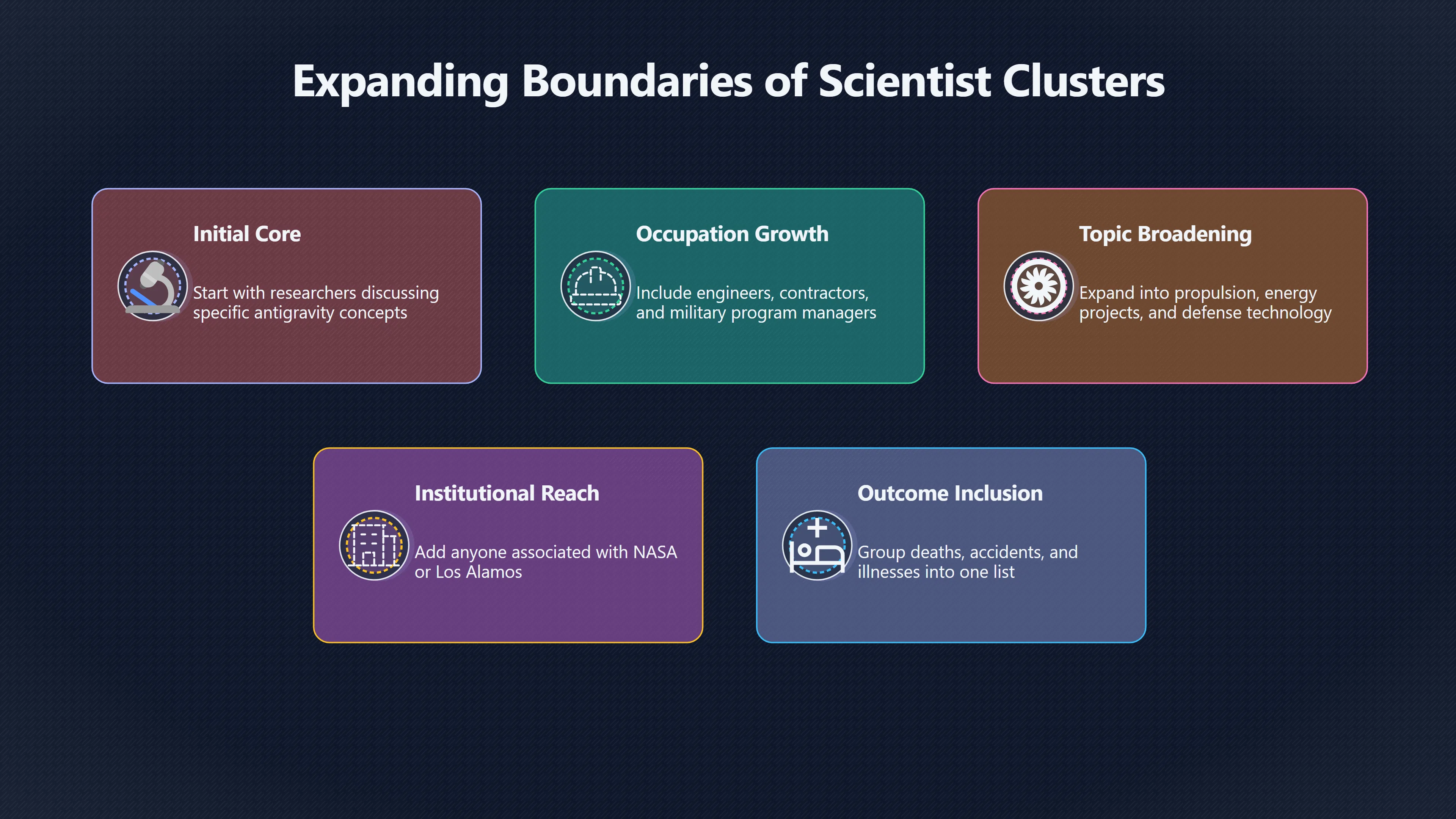
In many UFO- and advanced-propulsion narratives, the category expands gradually. A list may begin with a researcher who publicly discussed antigravity concepts. It then adds a physicist who worked at a defence laboratory, an aerospace engineer who worked near a classified programme, a retired military official associated with UFO discussions, and eventually people whose connection is only indirect. The resulting group appears specialised even though the members may come from very different fields.[Wikipedia]WikipediaMissing scientists conspiracy theoryMissing scientists conspiracy theory
Several boundary choices can dramatically change the appearance of a pattern:
- Occupation expansion: “Scientist” may come to include engineers, programme managers, military officers, contractors and former officials.
- Topic expansion: “Antigravity” may broaden into propulsion research, aerospace work, energy projects, defence technology or UFO interest.
- Institution expansion: Anyone associated with NASA, Los Alamos, the Air Force Research Laboratory, MIT, Caltech or similar institutions may be treated as part of the same story despite unrelated work.
- Outcome expansion: Deaths, disappearances, accidents, illnesses, homicides and suicides may all be grouped together despite very different circumstances.
Each expansion increases the pool of eligible cases. The larger the pool becomes, the easier it is to find apparently striking examples.[Wikipedia]WikipediaMissing scientists conspiracy theoryMissing scientists conspiracy theory
This does not prove that a cluster is false. It means the reader should ask a basic methodological question: would the same list exist if strict inclusion rules had been defined before any names were collected?
Why Timing Can Create False Patterns
Timing is often the strongest emotional element in a cluster claim.
A common presentation method places multiple events into a short narrative sequence. Cases that occurred years apart can be arranged into a single timeline, making them appear part of a concentrated wave. In discussions surrounding alleged UFO- and antigravity-related deaths, some lists have combined events spanning several years while presenting them as a single emerging pattern. Journalistic reviews of these claims noted that cases cited by proponents involved different causes of death and occurred across a broad time period rather than within one tightly defined episode.[Wikipedia]WikipediaMissing scientists conspiracy theoryMissing scientists conspiracy theory
This effect is related to what statisticians and sceptical analysts describe as the clustering illusion or Texas sharpshooter fallacy. The underlying mistake is to identify a pattern after seeing the data rather than defining the pattern beforehand. A cluster is treated as meaningful because attention is focused on similarities while differences are ignored.[wikipedia.org]WikipediaTexas sharpshooter fallacyTexas sharpshooter fallacy
The metaphor is simple: a shooter fires randomly at a barn and then paints a target around the densest concentration of bullet holes. The cluster looks impressive because the boundaries were drawn after the fact. The same logic can apply to scientist-death lists when names are selected first and a unifying explanation is proposed afterwards.[Wikipedia]WikipediaTexas sharpshooter fallacyTexas sharpshooter fallacy
Why Missing Cases Matter as Much as Included Cases
One of the strongest tests of a cluster is to examine what was excluded.
If a list highlights eleven deaths or disappearances linked to aerospace or advanced research, a critical question is how many comparable researchers experienced no unusual outcome during the same period. Without that denominator, it is impossible to know whether the highlighted cases are statistically remarkable.[Scientific American]scientificamerican.comScientific AmericanMath and statistics help explain the FBI's 'missing scientists'…Statistical principles show you don't need a nefari…
Large scientific and defence communities contain thousands of people. Over several years, some members will die from illness, accidents, homicide, suicide or natural causes simply because such events occur in any large population. A cluster can seem extraordinary when only the selected cases are visible and the much larger background population disappears from view.[Scientific American]scientificamerican.comScientific AmericanMath and statistics help explain the FBI's 'missing scientists'…Statistical principles show you don't need a nefari…
This is why epidemiologists and statisticians are cautious about claims based solely on apparent concentrations of events. A visible cluster is not automatically evidence of a common cause. The question is whether the observed number exceeds what would reasonably be expected once the size of the underlying population is considered.[fallacyfiles.org]fallacyfiles.orgFallacy FilesThe Texas Sharpshooter FallacyThis fallacy occurs when someone jumps to the conclusion that a cluster in data must be the re…
What Evidence Would Actually Connect Separate Cases?
A genuine linked series of deaths would require more than thematic similarities.
The strongest forms of evidence would include:
- Shared suspects, organisations or operational methods.
- Documented threats directed at multiple individuals.
- Communications showing coordination among perpetrators.
- Consistent forensic findings across cases.
- Intelligence, law-enforcement or court evidence establishing a common actor.
- Demonstrable links between the victims beyond broad occupational categories.
By contrast, weaker indicators include:
- Employment in related industries.
- Interest in UFOs or advanced propulsion.
- Residence in the same country.
- Similar job titles.
- Deaths occurring within a broad period of years.
Those similarities can be useful starting points for investigation, but they do not by themselves establish a coordinated campaign.[Wikipedia]WikipediaTexas sharpshooter fallacyTexas sharpshooter fallacy
The Mechanism Behind the Persuasion
Scientist-death clusters feel convincing because they combine several powerful psychological effects at once.
The cases involve real people, often connected to advanced technology, classified work or subjects already associated with secrecy. The events are emotionally charged. The names are collected into a single narrative. Similarities are emphasised, differences are compressed, and the resulting list appears more coherent than the underlying evidence may justify. Analysts of recent “missing scientists” claims have argued that this process can transform a collection of unrelated incidents into what looks like a single mystery, even when public evidence for a common cause remains absent.[Wikipedia]WikipediaMissing scientists conspiracy theoryMissing scientists conspiracy theory
For readers evaluating suspicious death claims connected to UFO or antigravity research, the key lesson is that a cluster is not evidence by itself. The cluster is the starting point. The real question is whether the connections existed before the list was assembled, or whether the list itself created the appearance of a connection.[Wikipedia]WikipediaTexas sharpshooter fallacyTexas sharpshooter fallacy
Amazon book picks
Further Reading
Books and field guides related to Why Scientist Death Lists Feel Convincing. Use these as the next step if you want deeper reading beyond the article.
Fooled by Randomness
Rating: 4.0/5 from 15 Google Books ratings
Helps readers understand how random events can be misinterpreted as deliberate or connected.
The Demon-Haunted World
Rating: 4.5/5 from 43 Google Books ratings
Directly addresses how people can be persuaded by weak evidence, apparent patterns, and conspiracy-style narratives.
Thinking, Fast and Slow
Explains cognitive biases that make clusters, coincidences, and selective evidence appear meaningful.
The Believing Brain
Focuses on why people form beliefs, detect patterns, and maintain conspiracy-style explanations.
eBay marketplace picks
Marketplace Samples
Live-tested eBay searches with available results related to this page.

Endnotes
1.
Source: Wikipedia
Title: Texas sharpshooter fallacy
Link:https://en.wikipedia.org/wiki/Texas_sharpshooter_fallacy
2.
Source: Wikipedia
Title: Missing scientists conspiracy theory
Link:https://en.wikipedia.org/wiki/Missing_scientists_conspiracy_theory
3.
Source: scientificamerican.com
Link:https://www.scientificamerican.com/article/math-and-statistics-help-explain-the-fbis-missing-scientists-cases/
Source snippet
Scientific AmericanMath and statistics help explain the FBI's 'missing scientists'...Statistical principles show you don't need a nefari...
4.
Source: fallacyfiles.org
Link:https://www.fallacyfiles.org/texsharp.html
Source snippet
Fallacy FilesThe Texas Sharpshooter FallacyThis fallacy occurs when someone jumps to the conclusion that a cluster in data must be the re...
5.
Source: gui.do
Title: do Jansen Texas sharpshooter fallacy
Link:https://gui.do/post/texas-sharpshooter-fallacy/
Source snippet
Texas sharpshooter fallacy - Guido Jansen11 Dec 2017 — The clustering of houses for sale could also just be a coincidence without a cause...
Additional References
6.
Source: instagram.com
Link:https://www.instagram.com/reel/DXP-XYZgUAH/
Source snippet
[Amy Eskridge]({{ 'amy-eskridge/' | relative_url }})'s death is the latest to be grouped in...SCIENTIST #1 Amy Eskridge Independent researcher... UFO / extraterrestrial resear...
7.
Source: the-sun.com
Link:https://www.the-sun.com/news/16236206/scientist-dead-after-danger-warning-trump-vows-answers/
Source snippet
Space scientist found dead after warning 'my life is in danger' becomes ELEVENTH mysterious case as Trump vows answers. Georgie...Read more...
8.
Source: facebook.com
Link:https://www.facebook.com/arynewsasia/posts/amy-eskridges-mysterious-death-ufo-researchers-final-texts-spark-conspiracy-theo/1460897642728357/
Source snippet
UFO Researcher's Final Texts Spark Conspiracy Theories#UFO #Mystery #Aliens #Discovery #MysteriousHistory #StrangeObjects #Alien · May be...
9.
Source: yourlogicalfallacyis.com
Link:https://yourlogicalfallacyis.com/the-texas-sharpshooter
Source snippet
Your logical fallacy is the texas sharpshooterThis 'false cause' fallacy is coined after a marksman shooting randomly at barns and then p...
10.
Source: logicallyfallacious.com
Link:https://www.logicallyfallacious.com/logicalfallacies/Texas-Sharpshooter-Fallacy
Source snippet
Texas Sharpshooter Fallacy(also known as: clustering illusion). Description: Ignoring the difference while focusing on the similarities...
11.
Source: nypost.com
Link:https://nypost.com/2026/04/17/us-news/string-of-missing-of-dead-scientists-too-coincidental-congressman-says-as-a-11th-researcher-revealed/
Source snippet
String of missing or dead scientists 'too coincidental' not...17 Apr 2026 — Eskridge revealed in a 2020 interview that she had plans to...
12.
Source: mycharisma.com
Link:https://mycharisma.com/culture/mystery-deepens-after-11th-scientist-death-linked-to-ufo-and-anti-gravity-research/
Source snippet
Mystery Deepens After 11th Scientist Death Linked to UFO...17 Apr 2026 — Mysterious death of anti-gravity scientist adds to 11 cases inv...
13.
Source: brobible.com
Link:https://brobible.com/sports/article/scientist-11th-person-secret-research-missing-die/
Source snippet
Scientist Amy Eskridge, who died at the age of 34, is now the eleventh person with connections to...Read more...
14.
Source: radaronline.com
Link:https://radaronline.com/p/top-scientists-dead-or-missing-conspiracy-amy-eskridge-jason-thomas-trump/
Source snippet
extraterrestrial life. Then, in May 2025, 79-year-old Anthony... UFO researcher, David Wilcock had also called the situation 'scary...R...
Published: May 2025
15.
Source: statology.org
Link:https://www.statology.org/the-texas-sharpshooter-fallacy-drawing-bullseyes-after-the-data-is-in/
Source snippet
The Texas Sharpshooter Fallacy: Drawing Bullseyes After...26 Mar 2026 — Learn how the Texas Sharpshooter Fallacy causes misleading patte...
Topic Tree