Within Viral Lists
Why Long Lists Feel Like Evidence
Long lists feel persuasive because readers naturally search for patterns, even when the cases differ in role, timing and evidence.
On this page
- Why accumulation changes perception
- How unrelated cases become a pattern
- Checks that reduce false connections
Page outline Jump by section
Introduction
Long lists of allegedly suspicious deaths and disappearances connected to UFOs, antigravity research, aerospace programmes, or classified science often feel convincing before any individual case is examined. The psychological mechanism behind that reaction is known as illusory pattern perception: the tendency to see meaningful connections among events that may be unrelated. Research in psychology has repeatedly found that people who are more prone to perceiving patterns in random or weakly related information are also more likely to endorse conspiracy theories.[PubMed]pubmed.ncbi.nlm.nih.govIllusory pattern perception predicts belief in conspiracies…by JW van Prooijen · 2018 · Cited by 476 — We conclude that illusory…
 Within UFO death-list narratives, the persuasive force frequently comes not from strong evidence linking cases, but from the accumulation of names. Once enough entries appear together, the human mind naturally begins searching for a common cause. The result is that a collection of different events—suicides, homicides, accidents, natural deaths, disappearances, and unresolved investigations—can start to feel like a single coordinated story even when no verified connection has been established.[nih.gov]pubmed.ncbi.nlm.nih.govIllusory pattern perception predicts belief in conspiracies…by JW van Prooijen · 2018 · Cited by 476 — We conclude that illusory…
Why Accumulation Changes Perception
Humans evolved to detect patterns. In most situations this is useful: recognising relationships between events helps people navigate a complex world. The problem arises when the pattern-detection system becomes more influential than the underlying evidence.
Psychologists use terms such as apophenia, patternicity, and clustering illusion to describe situations where people perceive meaningful structure in coincidences, random events, or weak associations. The tendency is not limited to UFO topics; it appears in gambling beliefs, paranormal claims, financial speculation, and conspiracy thinking more generally.[wikipedia.org]WikipediaOpen source on wikipedia.org.
A long UFO death list creates several conditions that encourage this effect:
- The names are presented together rather than separately.
- The events are framed under a single label such as “scientists who knew too much”.
- Similarities are highlighted while differences are minimised.
- The reader encounters the proposed pattern before reviewing the evidence for each case.
Once readers begin looking for a hidden connection, each additional name can seem to confirm the emerging narrative. Yet psychologically, the length of a list is not itself evidence that the listed events share a common cause.[PubMed]pubmed.ncbi.nlm.nih.govIllusory pattern perception predicts belief in conspiracies…by JW van Prooijen · 2018 · Cited by 476 — We conclude that illusory…
The Emotional Weight of Numbers
A list of ten names feels more significant than a list of two names. This reaction is understandable, but it can be misleading.
Research on conspiracy beliefs suggests that people often infer agency when confronted with clusters of unusual events. If several deaths involve individuals associated with aerospace, defence, advanced energy, or UFO-related discussions, observers may conclude that coincidence is becoming implausible. However, that judgement is frequently made before calculating how many people work in those sectors, how many deaths would normally occur over the relevant time period, or whether the cases actually share meaningful similarities.[nih.gov]pubmed.ncbi.nlm.nih.govIllusory pattern perception predicts belief in conspiracies…by JW van Prooijen · 2018 · Cited by 476 — We conclude that illusory…
How Unrelated Cases Become a Pattern
The transformation from separate incidents into an apparent conspiracy often follows a recognisable sequence.
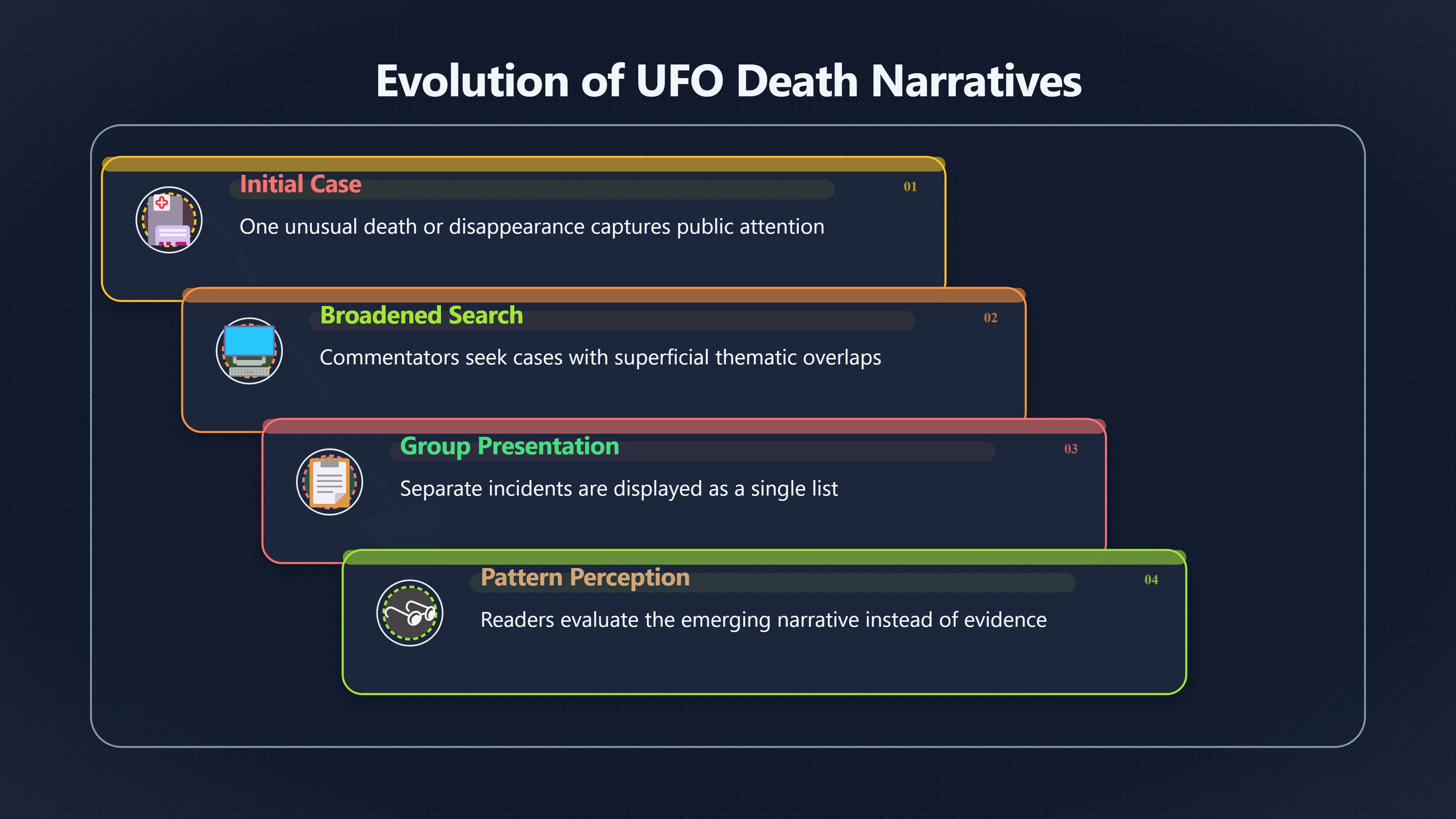
First, one genuinely unusual case attracts attention. A disappearance, unexplained death, or controversial investigation becomes the focal point.
Second, researchers or online commentators search for comparable incidents. The search criteria then broaden. Instead of asking whether another case has the same evidence, the question becomes whether it shares any superficial characteristic: work in aerospace, security clearances, defence employment, energy research, or a historical connection to UFO discussions.
Third, the cases are presented together. At that stage, readers no longer evaluate each event independently. They evaluate the apparent pattern.
This process was visible in the 2026 “missing scientists” controversy. Media reports noted that online speculation expanded from a small number of cases to a list of roughly a dozen deaths or disappearances. At the same time, journalists, scientists, family members, and investigators repeatedly stated that no definitive evidence had established a common cause linking the incidents. The Wall Street Journal+3The Washington Post+3Wikipedia[washingtonpost.com]washingtonpost.comThe Washington Post How conspiracy theories about missing or dead scientistsscientists who have died or disappeared in recent years was largely confined to niche online…
The Role of Similarity Without Connection
Many UFO death lists rely on what might be called category similarity rather than demonstrated linkage.
For example, individuals may be grouped together because they:
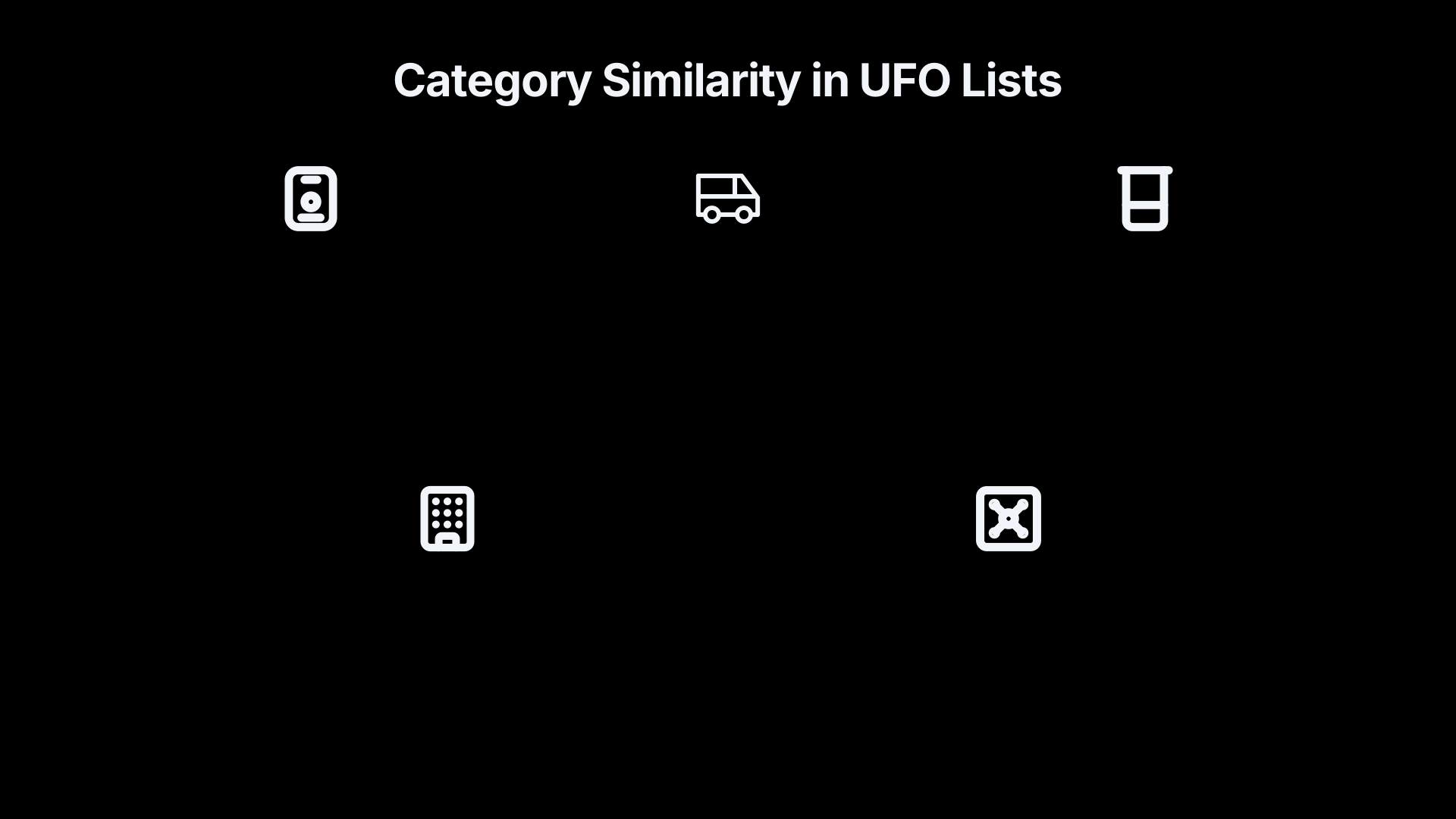
- Worked in aerospace or defence.
- Held security clearances.
- Had some association with advanced propulsion or energy research.
- Appeared in UFO-related discussions.
- Worked at institutions that have featured in UFO folklore.
Those similarities are real. The leap occurs when similarity is treated as evidence of coordination.
A retired military officer, a laboratory administrator, a NASA researcher, an antigravity enthusiast, and a missing contractor may all fit within a broad “sensitive science” category. Yet that does not automatically create a causal relationship between their deaths or disappearances. Several analyses of the 2026 scientist-list claims reached precisely this conclusion: the cases shared broad thematic overlaps but lacked demonstrated operational connections.[Wikipedia]WikipediaMissing scientists conspiracy theoryMissing scientists conspiracy theory
Why Contradictory Details Fade Into the Background
Illusory pattern perception is strengthened when disconfirming information receives less attention than confirming information.
In UFO death lists, readers often remember:
- The number of names.
- The association with secret research.
- The fact that several cases remain unresolved.
They are less likely to remember:
- Different causes of death.
- Different time periods.
- Different employers.
- Different personal circumstances.
- Cases already explained by investigators.
As a result, the pattern becomes psychologically stronger than the underlying evidence. Researchers studying conspiracy belief have found that pattern perception can influence how people interpret ambiguous information, making weak connections appear more meaningful than they objectively are.[nih.gov]pubmed.ncbi.nlm.nih.govIllusory pattern perception predicts belief in conspiracies…by JW van Prooijen · 2018 · Cited by 476 — We conclude that illusory…
Checks That Reduce False Connections
Illusory pattern perception does not mean that all suspicious deaths are unrelated. Real conspiracies have existed throughout history. The question is whether the evidence demonstrates a connection rather than merely suggesting one.
Several practical checks help distinguish a genuine pattern from a perceived one.
Separate Every Case
The most effective test is to examine each death or disappearance independently before considering broader conclusions.
Questions include:
- What is the verified cause of death?
- What evidence exists for foul play?
- What did investigators conclude?
- What specific UFO or antigravity connection is documented?
- What evidence links this case to another case?
If the connection disappears when cases are examined individually, the broader pattern may be illusory.

Look for Base Rates
Large scientific, defence, and aerospace communities contain hundreds of thousands of workers. Over several years, some members will die from natural causes, accidents, homicide, suicide, or unresolved circumstances.
Critics of recent “missing scientist” narratives have argued that normal mortality and crime statistics must be considered before concluding that a cluster is extraordinary. Without a baseline comparison, unusual events can appear more significant than they actually are.[Wikipedia]WikipediaMissing scientists conspiracy theoryMissing scientists conspiracy theory
Distinguish Unknown From Connected
An unsolved case is not automatically evidence of a conspiracy.
A disappearance may remain unexplained because evidence is incomplete. A death may be suspicious without being linked to any larger network. Treating every unanswered question as proof of coordination creates a pattern by assumption rather than by demonstration.
Ask What Evidence Would Disprove the Theory
A useful safeguard is to identify what information would count against the proposed pattern.
If natural deaths, suicides, solved crimes, and unrelated disappearances are all absorbed into the same narrative regardless of new evidence, the pattern has become unfalsifiable. At that point, the theory is being maintained by interpretation rather than investigation.
The Pattern Trap
The most important lesson from UFO death lists is not that every alleged connection is false. It is that human beings are highly sensitive to patterns, especially when those patterns involve secrecy, tragedy, and high-stakes subjects such as advanced technology or extraterrestrial claims.
Long lists feel persuasive because accumulation itself changes perception. A collection of names can create the impression of hidden design before the reader has verified whether the cases share timing, motive, perpetrators, methods, or evidence. Psychological research on illusory pattern perception helps explain why these narratives are often compelling even when the factual links remain weak, disputed, or entirely unproven.[nih.gov]pubmed.ncbi.nlm.nih.govIllusory pattern perception predicts belief in conspiracies…by JW van Prooijen · 2018 · Cited by 476 — We conclude that illusory…
Amazon book picks
Further Reading
Books and field guides related to Why Long Lists Feel Like Evidence. Use these as the next step if you want deeper reading beyond the article.
Why People Believe Weird Things
Examines paranormal, conspiracy, and pseudoscientific beliefs, including misinterpretation of evidence.
The Believing Brain
Explains pattern detection, agency attribution, and why people connect unrelated events into compelling narratives.
Suspicious Minds
Directly addresses the cognitive mechanisms that make long lists and coincidences feel evidential.
Thinking, Fast and Slow
Provides foundational understanding of cognitive biases and intuitive judgments that encourage false pattern detection.
eBay marketplace picks
Marketplace Samples
Live-tested eBay searches with available results related to this page.



Endnotes
1.
Source: psyche.co
Title: when the human tendency to detect patterns goes too far
Link:https://psyche.co/ideas/when-the-human-tendency-to-detect-patterns-goes-too-far
Source snippet
19 Sept 2023 — Apophenia is the cognitive tendency that helps explain Rorschach tests, sports superstitions, astrology and decisions like...
2.
Source: Wikipedia
Title: Missing scientists conspiracy theory
Link:https://en.wikipedia.org/wiki/Missing_scientists_conspiracy_theory
3.
Source: Wikipedia
Link:https://en.wikipedia.org/wiki/Apophenia
4.
Source: researchgate.net
Link:https://www.researchgate.net/publication/319209212_Connecting_the_Dots_Illusory_Pattern_Perception_Predicts_Belief_in_Conspiracies_and_the_Supernatural
Source snippet
Illusory Pattern Perception Predicts Belief in Conspiracies...We conclude that illusory pattern perception is a central cognitive mechan...
5.
Source: researchgate.net
Link:https://www.researchgate.net/publication/332106224_Finding_meaning_in_the_clouds_Illusory_pattern_perception_predicts_receptivity_to_pseudo-profound_bullshit
Source snippet
Finding meaning in the clouds: Illusory pattern perception...31 Mar 2019 — Previous research has demonstrated a link between illusory pa...
6.
Source: pubmed.ncbi.nlm.nih.gov
Link:https://pubmed.ncbi.nlm.nih.gov/29695889/
Source snippet
Illusory pattern perception predicts belief in conspiracies...by JW van Prooijen · 2018 · Cited by 476 — We conclude that illusory...
7.
Source: research.vu.nl
Title: connecting the dots illusory pattern perception predicts belief i
Link:https://research.vu.nl/en/publications/connecting-the-dots-illusory-pattern-perception-predicts-belief-i/
Source snippet
Vrije Universiteit AmsterdamIllusory pattern perception predicts belief in conspiracies...by JW van Prooijen · 2018 · Cited by 473 — A c...
8.
Source: pmc.ncbi.nlm.nih.gov
Title: PMCApophenia as the Disposition to False Positives
Link:https://pmc.ncbi.nlm.nih.gov/articles/PMC7112154/
Source snippet
as the Disposition to False Positives - PMC - NIHby SD Blain · 2020 · Cited by 123 — One promising framework for explaining positive symp...
9.
Source: washingtonpost.com
Title: The Washington Post How conspiracy theories about missing or dead scientists
Link:https://www.washingtonpost.com/politics/2026/04/24/scientists-missing-dead-conspiracy-theories/73473d76-4013-11f1-bb46-ed564688d953_story.html
Source snippet
scientists who have died or disappeared in recent years was largely confined to niche online...
10.
Source: wsj.com
Link:https://www.wsj.com/politics/national-security/how-a-fringe-conspiracy-theory-about-missing-scientists-got-the-fbis-attention-d61de97c
Source snippet
The case of Melissa Casias, a New Mexico administrative assistant gone missing, became a flashpoint, with internet theorists linking her...
11.
Source: scribd.com
Link:https://www.scribd.com/document/524051505/Apophenia-Wikipedia
Source snippet
is the tendency to perceive meaningful connections between unrelated things.[1] The term (German: Apophänie) was...Read more...
Additional References
12.
Source: facebook.com
Link:https://www.facebook.com/groups/Worldpaintings/posts/10156603903467913/
Source snippet
Arcimboldo's art and human pattern recognitionApophenia is also typical of conspiracy theory, where coincidences may be woven together in...
13.
Source: facebook.com
Link:https://www.facebook.com/scienceexplorist/posts/science-suggests-that-conspiracy-thinking-isnt-just-about-misinformationits-also/940235891894772/
Source snippet
How conspiracy theories affect brain processingNew psychological research shows that people who strongly believe in conspiracy theories t...
14.
Source: nypost.com
Link:https://nypost.com/2026/04/18/us-news/former-top-nuclear-official-says-feds-likely-to-uncover-crazy-stuff-about-11-missing-or-dead-scientists/
Source snippet
nuclear official, Frank Rose, has commented on the ongoing federal investigation into the mysterious disappearances and deaths of 11 scie...
15.
Source: cogbias.site
Link:https://cogbias.site/patterns/outcome/
Source snippet
Outcome | CogBiasApophenia. The tendency to perceive meaningful connections or patterns between unrelated things. Causal AttributionOutco...
16.
Source: theguardian.com
Link:https://www.theguardian.com/world/2026/apr/25/conspiracy-theory-ufo-scientists-[white-house
Source snippet
scientists connected to space, nuclear, or defense research has rapidly spread online, drawing the attention of right-wing media, Congres...
17.
Source: bps.org.uk
Link:https://www.bps.org.uk/research-digest/believers-conspiracy-theories-and-paranormal-are-more-likely-see-illusory-patterns
Source snippet
British Psychological SocietyBelievers in conspiracy theories and the paranormal are...17 Oct 2017 — Recent research investigates whethe...
18.
Source: openaccess.wgtn.ac.nz
Title: The Psychopathological Foundations of Conspiracy Theorists
Link:https://openaccess.wgtn.ac.nz/articles/thesis/The_Psychopathological_Foundations_of_Conspiracy_Theorists/17008057
Source snippet
Psychopathological Foundations of Conspiracy Theoristsby DJ Kumareswaran · 2014 · Cited by 19 — The primary aim of this thesis was to und...
19.
Source: scispace.com
Link:https://scispace.com/pdf/linking-paranormal-and-conspiracy-beliefs-to-illusory-d3wx5k7g.pdf
Source snippet
has been tested less extensively, but findings suggest they might be...Read more...
20.
Source: semanticscholar.org
Link:https://www.semanticscholar.org/paper/Connecting-the-dots%3A-Illusory-pattern-perception-in-Prooijen-Douglas/46d3bc13fb1ec1c83864692908cfbdb3d3e8f17a
Source snippet
chanism accounting for conspiracy theories and supernatural beliefs...
21.
Source: youtube.com
Title: Energy directed weapons, UFOs, and missing scientists
Link:https://www.youtube.com/watch?v=UrJz-cDcCtc
Source snippet
Major Gen. William McCasland ran the Air Force's secret lab — then DISAPPEARED...
Topic Tree