Within Antigravity
Why Superconductors Attract Antigravity Rumors
Superconductors became central to antigravity speculation because they sounded experimentally testable while remaining hard for outsiders to evaluate.
On this page
- Why superconductors made gravity claims feel scientific
- How Li and Podkletnov shaped the public storyline
- What small measurements can and cannot show
Page outline Jump by section
Introduction
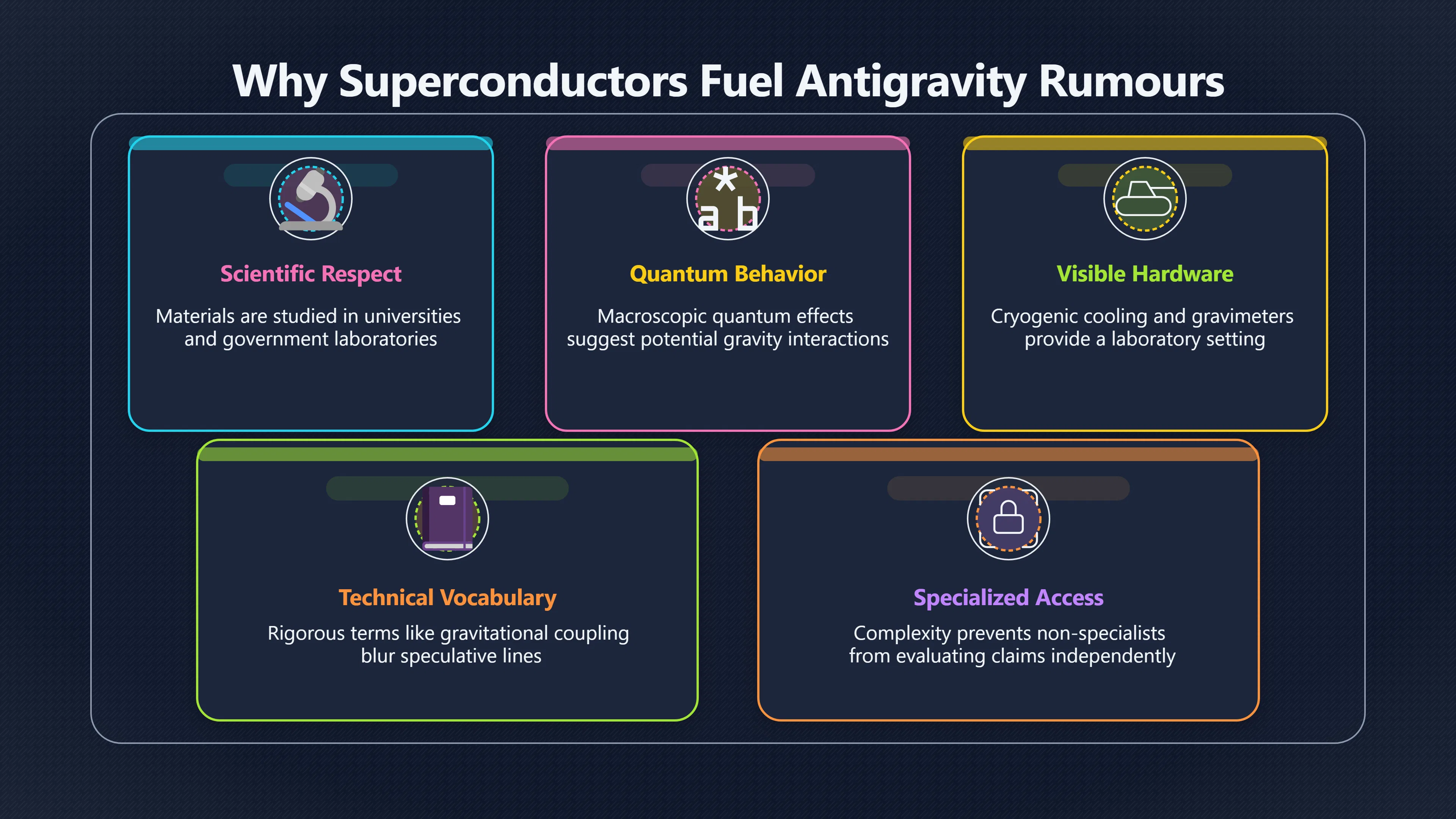
Within the wider network of UFO and antigravity rumours, superconductors became the ideal bridge between science fiction and laboratory science. Unlike vague claims about secret propulsion systems, superconductors were real materials studied in universities, government laboratories and aerospace programmes. They offered something that antigravity stories often lack: technical terminology, published papers, specialised equipment and experiments that appeared testable by physicists.
 This combination made superconductors unusually attractive to speculation. A claim involving a rotating superconducting disc sounded more scientific than a claim about an unknown energy source, yet it remained difficult for non-specialists to evaluate. As a result, a small body of controversial research became one of the most persistent foundations of modern antigravity folklore, especially around the work of Ning Li and Eugene Podkletnov. The evidence shows genuine scientific investigation into possible gravity-related effects, but it does not show a demonstrated antigravity technology. The gap between those two realities is where many of the rumours took root. NASA Technical Reports Server+2NASA Technical Reports Server[ntrs.nasa.gov]ntrs.nasa.govThis result puts new limits…Read more…
Why superconductors made gravity claims feel scientific
Superconductors are materials that conduct electricity with essentially zero resistance below a critical temperature. Because they exhibit unusual quantum behaviour on a macroscopic scale, some researchers wondered whether they might interact with gravity in unexpected ways.
That idea gained traction partly because gravity remains the least experimentally accessible of the fundamental interactions. Even modest theoretical suggestions that superconductors might influence gravitational fields seemed worth examining. The resulting discussions used concepts such as gravitomagnetism, quantum coherence and gravitational coupling, creating a vocabulary that sounded rigorous and advanced. For non-experts, this technical language often blurred the distinction between speculative hypotheses and experimentally verified effects.
The attraction was reinforced by the fact that the experiments involved visible hardware rather than abstract mathematics. High-temperature ceramic superconductors, magnetic levitation systems, cryogenic cooling and precision gravimeters gave the subject a laboratory setting. This made claims of gravity modification appear closer to engineering than to speculation, even when the reported effects were tiny, uncertain or unreplicated. NASA Technical Reports Server+2NASA Technical Reports Server[ntrs.nasa.gov]ntrs.nasa.govThis result puts new limits…Read more…
In UFO-related discussions, this laboratory setting proved especially important. If antigravity propulsion existed, superconductors seemed to offer a plausible route by which researchers might discover it. As a result, scientists associated with superconducting gravity experiments often became recurring figures in stories about hidden technologies, classified aerospace projects and alleged suppression.
How Li and Podkletnov shaped the public storyline
Ning Li and the promise of measurable effects
Ning Li’s work became influential because it emerged from mainstream physics rather than fringe speculation. In the early 1990s, she and collaborators published theoretical papers exploring possible interactions between superconductors and gravitomagnetic fields. Those papers did not demonstrate antigravity, but they provided a scientific framework for discussing whether superconductors could influence gravity-related phenomena.[NASA Technical Reports Server]ntrs.nasa.govThis result puts new limits…Read more…
What is often overlooked in later retellings is that experimental efforts associated with Li’s research generally produced null or extremely small results. A NASA-linked investigation involving type-II YBCO superconductors measured changes in acceleration smaller than two parts in one hundred million of normal gravity. The authors presented this as a constraint on proposed effects rather than evidence of useful gravity control.[NASA Technical Reports Server]ntrs.nasa.govThis result puts new limits…Read more…
Yet in rumour networks, the existence of the experiment frequently matters more than its outcome. The fact that scientists were testing superconductors for gravity-related effects is often transformed into the claim that gravity manipulation had already been demonstrated and later hidden.
Eugene Podkletnov and the gravity-shielding narrative
If Li provided the theoretical language, Eugene Podkletnov supplied the dramatic experimental story. In the 1990s he reported that objects positioned above a rotating superconducting disc appeared to lose a small fraction of their weight. The claimed reduction was modest, but if genuine it would have represented a profound challenge to accepted physics.[wikipedia.org]WikipediaEugene PodkletnovSeptember 21, 2025 — Eugene Podkletnov is a Russian ceramics engineer known for his claims made in the 1990s of designing and demonstrati…
The claim attracted international attention because it appeared to offer something unprecedented: a laboratory device that could partially shield gravity. Media coverage amplified the story, and discussions quickly spread beyond physics into aerospace and UFO communities.[WIRED]wired.comBreaking the Law of Gravity1 Mar 1998 — A scientist claimed in 1996 that gravity could be negated. Now his findings are being invest…
However, the scientific response was cautious. Multiple researchers attempted replications, and several reported no detectable gravity-like effect within the sensitivity limits of their equipment. A notable replication effort specifically designed around Podkletnov’s published descriptions found no evidence for the claimed phenomenon. NASA-related reviews later noted that preliminary experiments had failed to observe the expected shielding effect.[researchgate.net]researchgate.netResearchGate(PDF) Gravity modification experiment using a rotating…The experiment is based on Podkletnov's published descriptions plus…
The result was an enduring stalemate. Supporters pointed to the originality of the claim and the difficulty of reproducing the apparatus. Critics pointed to the absence of consistent replication. Because neither side could completely close the discussion, the story remained fertile ground for speculation.[arxiv.org]arxiv.orgPodkletnov with YBCO superconductors have con- siderably modified the scenario of the search for gravity-superconductors…Read more…

What small measurements can and cannot show
A recurring misunderstanding in antigravity discussions is the difference between detecting an anomaly and demonstrating a practical technology.
Modern gravimeters and precision instruments can measure extraordinarily small changes in acceleration. Detecting a minute deviation is not equivalent to creating a propulsion system. Small anomalies may arise from magnetic fields, thermal gradients, vibration, calibration issues or experimental artefacts. Distinguishing a genuine gravitational effect from these influences is one of the central challenges of the field.[NASA Technical Reports Server]ntrs.nasa.govNASA Technical Reports ServerTest Status for Proposed Coupling of a Gravitational Force…by D Noever · 1999 — With magnetic shielding…
This distinction is crucial when interpreting both Li’s and Podkletnov’s work. Li’s experimental results primarily established upper limits on proposed effects rather than evidence for antigravity. Podkletnov’s reported weight reductions, meanwhile, remain controversial largely because independent laboratories have struggled to reproduce them reliably. NASA Technical Reports Server+2NASA Technical Reports Server[ntrs.nasa.gov]ntrs.nasa.govThis result puts new limits…Read more…
Even some researchers who continue exploring gravity–superconductor interactions acknowledge that the evidence remains inconclusive. Recent papers and preprints occasionally claim supporting observations, but these have not produced a broad scientific consensus comparable to established physical phenomena.[arXiv]arxiv.orgNew experimental evidence for Podkletnov effectby AV Fetisov · 2022 — Numerous attempts to replicate this experiment in other labora…
The scientific question therefore remains narrower than many rumours suggest. The issue is not whether gravity can already be engineered at will; it is whether any reproducible coupling between superconducting systems and gravity exists at all.
Why superconductors remain central to antigravity rumours
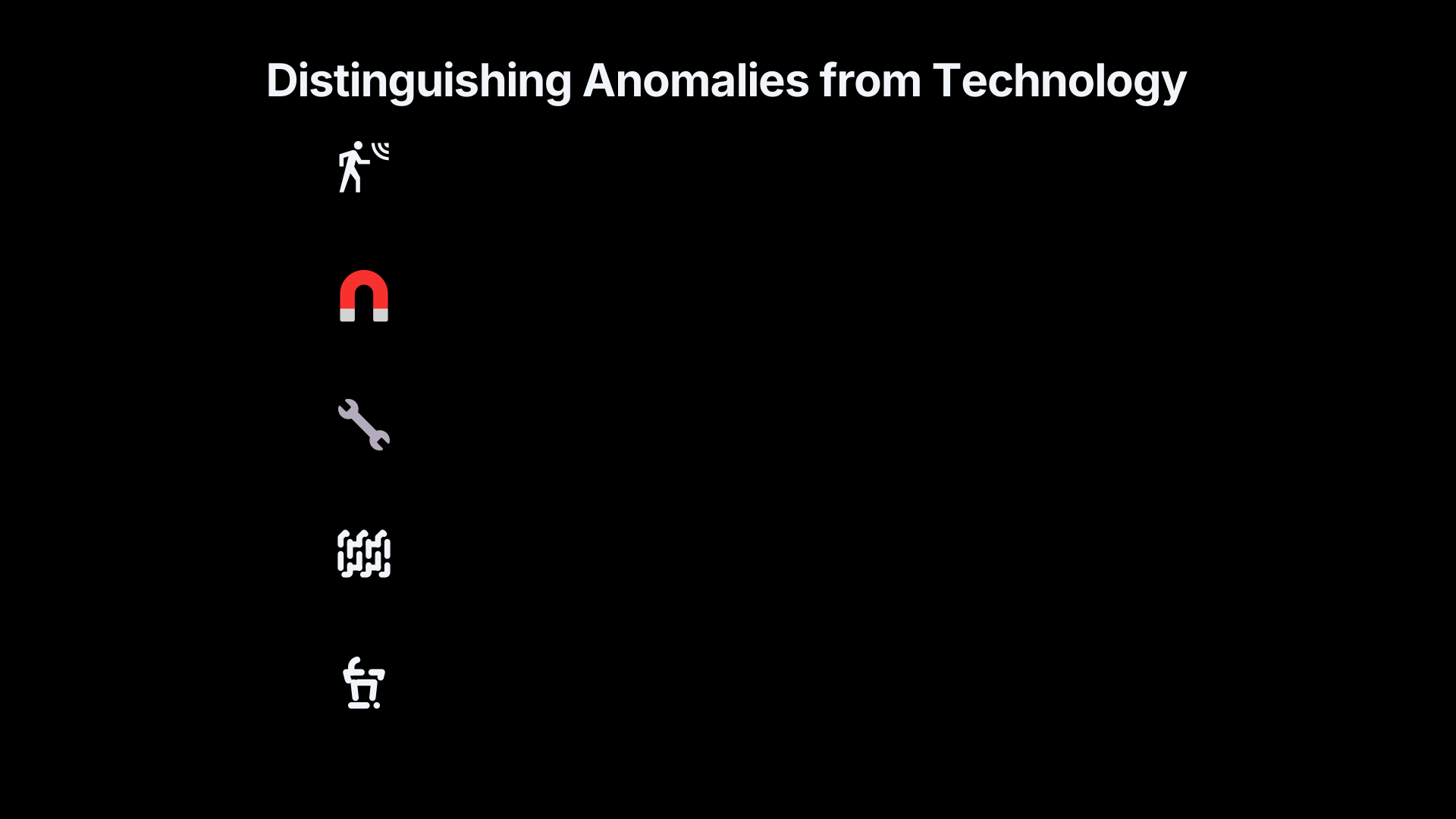
Superconductors occupy a unique position in the antigravity imagination because they satisfy several requirements simultaneously.
They are:
- Real and scientifically respected materials.
- Associated with unusual quantum behaviour.
- Expensive and technically difficult to work with.
- Linked to a handful of genuine gravity-related experiments.
- Accessible enough to discuss publicly but specialised enough that few people can independently evaluate the claims.
This combination allows the same evidence to support very different narratives. A physicist may see an unresolved experimental question. A conspiracy theorist may see proof of hidden propulsion technology. A UFO enthusiast may see a possible mechanism behind extraordinary flight characteristics.
As a result, superconductors became less important for what they conclusively demonstrated than for what they seemed to promise. The historical record shows serious investigations into possible gravity-related effects and several controversial claims. What it does not show is a verified antigravity device, a reproducible gravity shield or evidence that superconducting research uncovered operational UFO-style propulsion.[nasa.gov]ntrs.nasa.govThis result puts new limits…Read more…
That unresolved status is precisely why superconductors continue to function as the antigravity rumour magnet. They provide just enough scientific substance to sustain decades of speculation, while leaving the central claim unproven.
Amazon book picks
Further Reading
Books and field guides related to Why Superconductors Attract Antigravity Rumors. Use these as the next step if you want deeper reading beyond the article.
The Hunt for Zero Point
Directly covers antigravity claims, including stories and personalities associated with unconventional propulsion research.
Physics of the Impossible
Provides scientific context for why antigravity ideas persist and how speculative claims relate to established physics.
Hyperspace
Explores gravity, higher-dimensional theories, and the kinds of ideas that often feed antigravity speculation.
The Fabric of the Cosmos
Helps readers understand gravity, spacetime, and the limits of current physical theories relevant to extraordinary gravity claims.
eBay marketplace picks
Marketplace Samples
Live-tested eBay searches with available results related to this page.



Endnotes
1.
Source: ntrs.nasa.gov
Link:https://ntrs.nasa.gov/citations/19990039542
Source snippet
This result puts new limits...Read more...
2.
Source: ntrs.nasa.gov
Link:https://ntrs.nasa.gov/api/citations/19990046249/downloads/19990046249.pdf
Source snippet
Podkletnov has reported that a gravity shielding effect was seen above a YBCO superconductor being rotated by a magnetic field and irradi...
3.
Source: dia.mil
Title: File Id
Link:https://www.dia.mil/FOIA/FOIA-Electronic-Reading-Room/FileId/170046/
Source snippet
Role of Superconductors in Gravity ResearchMar 23, 2010 — In preliminary experiments at NASA, Koczor, Li, et al. failed to see expected s...
4.
Source: ntrs.nasa.gov
Link:https://ntrs.nasa.gov/citations/19990104365
Source snippet
NASA Technical Reports ServerTest Status for Proposed Coupling of a Gravitational Force...by D Noever · 1999 — With magnetic shielding...
5.
Source: arxiv.org
Link:https://arxiv.org/pdf/2206.07574
Source snippet
Podkletnov with YBCO superconductors have con- siderably modified the scenario of the search for gravity-superconductors...Read more...
6.
Source: Wikipedia
Title: Eugene Podkletnov
Link:https://en.wikipedia.org/wiki/Eugene_Podkletnov
Source snippet
September 21, 2025 — Eugene Podkletnov is a Russian ceramics engineer known for his claims made in the 1990s of designing and demonstrati...
Published: September 21, 2025
7.
Source: wired.com
Link:https://www.wired.com/1998/03/antigravity/
Source snippet
Breaking the Law of Gravity1 Mar 1998 — A scientist claimed in 1996 that gravity could be negated. Now his findings are being invest...
8.
Source: researchgate.net
Link:https://www.researchgate.net/publication/222897740_Gravity_modification_experiment_using_a_rotating_superconducting_disk_and_radio_frequency_fields
Source snippet
ResearchGate(PDF) Gravity modification experiment using a rotating...The experiment is based on Podkletnov's published descriptions plus...
9.
Source: arxiv.org
Link:https://arxiv.org/pdf/2209.03332
Source snippet
New experimental evidence for Podkletnov effectby AV Fetisov · 2022 — Numerous attempts to replicate this experiment in other labora...
10.
Source: arxiv.org
Title: arXiv New experimental evidence for Podkletnov effect
Link:https://arxiv.org/abs/2209.03332
11.
Source: Wikipedia
Title: Eugene, Oregon
Link:https://en.wikipedia.org/wiki/Eugene%2C_Oregon
Source snippet
Eugene, OregonThe second-most populous city in Oregon, Eugene had a population of 176,654 as of the 2020 United States census and it c...
12.
Source: researchgate.net
Link:https://www.researchgate.net/publication/370561828_A_Theory_of_the_Podkletnov_Effect_based_on_General_Relativity_Anti-Gravity_Force_due_to_the_Perturbed_Non-Holonomic_Background_of_Space
Source snippet
A Theory of the Podkletnov Effect based on General RelativityWe consider the Podkletnov effect — the weight loss of an object located ove...
13.
Source: researchgate.net
Link:https://www.researchgate.net/publication/354521867_A_simple_investigation_of_Static_test_for_a_gravitational_force_coupled_to_type_II_YBCO_superconductors_by_Li_and_coworkers
Source snippet
This result puts new limits on...
14.
Source: researchgate.net
Link:https://www.researchgate.net/publication/305635303_Null-Results_of_a_Superconducting_Gravity-Impulse-Generator
Source snippet
Null-Results of a Superconducting Gravity-Impulse-GeneratorIt was claimed by Podkletnov and Modanese that a high voltage discharge throug...
15.
Source: arxiv.org
Link:https://arxiv.org/pdf/physics/0108005
Source snippet
Impulse Gravity Generator Based on Charged Y...by E Podkletnov · 2001 · Cited by 45 — A typical time scale for the time-dependent Ginzbu...
Additional References
16.
Source: altpropulsion.com
Link:https://www.altpropulsion.com/people/eugene-podkletnov/
Source snippet
Eugene PodkletnovPodkletnov's experiments remain a reference point for discussions about whether condensed-matter systems can couple to g...
17.
Source: reddit.com
Link:https://www.reddit.com/r/EmDrive/comments/3dkeu3/podkletnov_gravity_modification_and_mihsc/
Source snippet
Podkletnov gravity modification and MiHsC: r/EmDrivePodkletnov is well-known for his experiments involving YBCO superconductors, which p...
18.
Source: youtube.com
Link:https://www.youtube.com/watch?v=zdewIFNQGaQ
19.
Source: youtube.com
Title: Gravity-Superconductors Interactions: Theory and Experiment by Giovanni Modanese
Link:https://www.youtube.com/watch?v=sH1p6Cn7ft4
Source snippet
Eugene Podkletnov antigravity superconductor mystery Eugene Podkletnov: Antigravity, Superconductors & Gravitational Impulse Force Beams...
20.
Source: medium.com
Link:https://medium.com/predict/eugene-podkletnovs-new-gravity-modification-experimental-video-b7813b04c6f8
Source snippet
Eugene Podkletnov developed a gravitational shield using high-speed rotating superconductors. Now he's testing a new device that he claim...
21.
Source: altpropulsion.com
Link:https://www.altpropulsion.com/superconductors-gravity-control/
Source snippet
Superconductors & Gravity Control: A 30-Year HistoryJul 9, 2025 — Ultimately, Drs Eugene Podkletnov and Ning Li both claimed experimental...
22.
Source: altpropulsion.com
Link:https://www.altpropulsion.com/ning-li-podkletnov-superconductors-gravity-control/
Source snippet
Ning Li, Podkletnov, Superconductors & Gravity ControlJun 22, 2025 — The conversation centers around the work of Eugene Podletnov, Dr...
23.
Source: altpropulsion.com
Title: podkletnovs four gravity control experiments
Link:https://www.altpropulsion.com/podkletnovs-four-gravity-control-experiments/
Source snippet
Podkletnov's Four Gravity Control ExperimentsMar 22, 2026 — Podkletnov's four gravity-control experiments, from rotating superconductors...
24.
Source: diyhpl.us
Title: eugene podkletnov gravity manipulation 2004
Link:https://diyhpl.us/wiki/transcripts/eugene-podkletnov-gravity-manipulation-2004/
Source snippet
eugene-podkletnov-gravity-manipulation-2004Jul 27, 2023 — podkletnov: no it is not secret we have two layers one layer is normal supercon...
25.
Source: youtube.com
Link:https://www.youtube.com/watch?v=7Xhxml67glM
Source snippet
The Scientist That "Discovered Antigravity" Then Disappeared Completely - An Unsolved Mystery...
Topic Tree